
LED billboard brightness at night: the rule Rio already has and Maringá is now debating
Maringá passed a 20% cap from 8 p.m. to 6 a.m. on first reading, Rio has required 10% since 2023 and some Brazilian cities banned LED or allow only DOOH. What changes for your screen, proposals and pricing
· Hivestr · 31 views
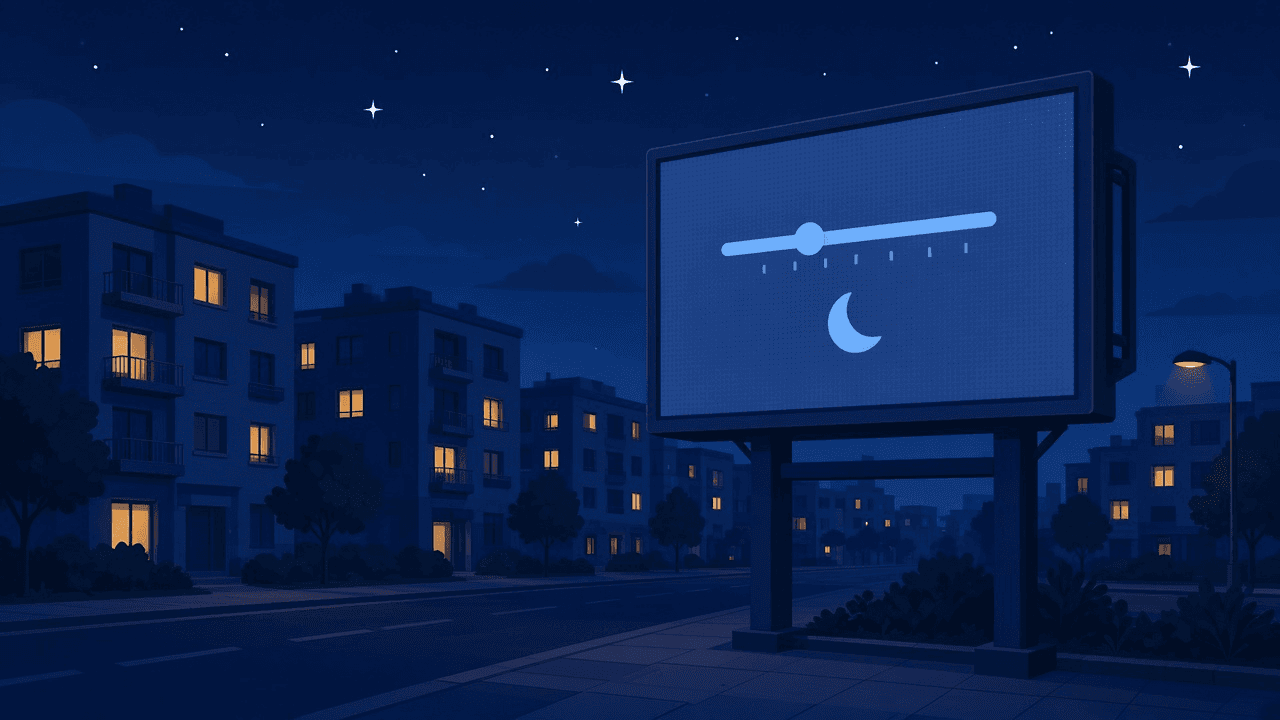
Last Thursday, October 8, the city council of Maringá, in the Brazilian state of Paraná, approved on first reading a bill that caps LED billboard brightness at 20% of capacity between 8 p.m. and 6 a.m., with automatic adjustment by sensor. It is not law yet. But the idea is not new: Rio de Janeiro has required 10% in the same hours since 2023, and other Brazilian cities have gone much further.
For DOOH media owners, night brightness is no longer just a neighbor's complaint. It has become a technical spec, a contract clause and a line in the cost sheet. Here we show which Brazilian cities already limit brightness (or LED itself), what that demands from your screen and how to bring the rule into your proposals and pricing.
This article is a reading guide for media owners and their sales teams, not legal advice. Municipal rules change, depend on implementing regulations and can be challenged in court. Before investing in upgrades or signing a contract in a city with a new rule, confirm the text in force with city hall and your lawyer.
What Maringá's council approved
Bill nº 17.830/2025, sponsored by councilman Mário Verri (PT), received 15 votes in favor on October 8, 2026. According to Maringá Post, the bill had been under discussion for about a year and requires digital billboards to run at no more than 20% of their light capacity between 8 p.m. and 6 a.m. Screens will need sensors that detect and automatically adjust light levels, with a gradual transition.
Three details matter for operators, according to reporting by Maringá PR Notícias:
The bill still needs at least one more vote and the mayor's signature, and it may be amended along the way. Until then, nobody can be fined under it. But anyone with a screen in Maringá already has a reason to check their equipment.
Rio has done it since 2023
Rio de Janeiro's Complementary Law nº 269/2023, published on December 13, 2023, is the closest precedent: same hours, a lower cap and restrictions that go beyond brightness.
The law gave licensed displays 90 days to adapt (art. 103). In Rio, night dimming is not a selling point. It is a condition for keeping the license.
Where the rules went much further
Maceió: LED visible from the street banned
On December 22, 2025, the city of Maceió, capital of Alagoas, issued Joint Ordinance GS/SEMSC/IPLAM nº 2. Article 2 bans LED or similar panels on private property when visible from public streets, "regardless of the technology used, format or size", and revokes permits already issued. Owners have 30 days after notice to remove them, removal by the city carries no compensation and the city may ask the power utility to cut the equipment's supply. The ordinance's stated reason is that city law had no provision for licensing LED panels. The city presented the measure as part of a reorganization of urban advertising.
Itaquaquecetuba: digital only, with a brightness ceiling
Going the other way, Itaquaquecetuba, in Greater São Paulo, banned static billboards and made DOOH the only outdoor media allowed. Complementary Law nº 440 of July 7, 2026, signed by the mayor after the council approved enrolled bill nº 49 on July 1 (bill PLC nº 452/2026), bans static vinyl, paper, frontlit and backlit displays and requires every screen, under art. 6, to meet:
| Requirement | What LC 440/2026 says |
|---|---|
| Luminance | Maximum 6,000 cd/m² by day and 300 cd/m² at night. |
| Dimming | Automatic and mandatory, with a built-in ambient light sensor. |
| Dwell time | Each ad stays on screen for at least 10 seconds. No strobe, flash or fast animation. |
| Monitoring | Remote system with auditable access for city inspectors. |
| Fines | Exceeding maximum luminance is a very serious offense (R$ 82,702.44). Failing the dimming standard is serious (R$ 55,134.96). |
The law also requires a license per screen (valid for 5 years) and a neighborhood impact study, and caps each operator or group at 25% of the city's licensed sites. What counts as "night" and which areas are off-limits are left to an implementing decree.
The cities side by side
| City | Rule | Status | What it means for LED |
|---|---|---|---|
| Rio de Janeiro | LC 269/2023 | In force | Max. 10% of capacity from 8 p.m. to 6 a.m. LED banned in Urca and Santa Teresa. |
| Maringá (PR) | Bill 17.830/2025 | Passed first reading on 10/08/2026. Not law. | Max. 20% of capacity from 8 p.m. to 6 a.m., with sensor and gradual transition. |
| Itaquaquecetuba (SP) | LC 440/2026 | Signed into law on 07/07/2026 | Only DOOH allowed. Max. 300 cd/m² at night and 6,000 cd/m² by day, sensor-based dimming. |
| Maceió (AL) | Joint Ordinance nº 2/2025 | Published 12/23/2025 | LED on private property visible from the street banned. Permits revoked. |
Status checked on October 13, 2026 against the sources cited throughout. Municipal rules may be followed by regulations, amendments or court rulings.
Percentage of capacity and cd/m² are not the same yardstick. Before saying your screen "already complies", find out which one your city uses.
Percentage or cd/m²: do the math for your screen
Rio and Maringá use a percentage of total capacity. Itaquaquecetuba uses absolute luminance, measured in candelas per square meter (cd/m², the same as "nits" on spec sheets). In practice, the first rule depends on your hardware and the second does not.
A hypothetical example, just to show the math: a screen whose spec sheet lists 6,000 cd/m² peak brightness could run at night at up to 600 cd/m² in Rio (10%) and up to 1,200 cd/m² in Maringá (20%), if the bill becomes law as written. In Itaquaquecetuba the ceiling would be 300 cd/m², whatever the panel. Take your manufacturer's spec sheet and redo the math with the real number.
None of these rules spells out a measurement method in its own text. Maringá and Itaquaquecetuba leave it to regulations. Until then, your best defense is a record: controller settings, brightness history by hour and, if possible, a luminance meter reading taken by a technician, with date and photo.
What it demands from your equipment
The good news is that dimming rarely means replacing the screen. The conversation is about the controller, the content management software and sometimes a sensor. Check with your supplier what your setup already does:
It is also worth reviewing night creative. Ask agencies for high-contrast artwork for the dimmed period, and remember that Itaquaquecetuba bans flashes and fast animation and requires at least 10 seconds per ad, which changes your spot schedule.
Bringing the rule into proposals and pricing
Brightness rules affect what you promise, what a site costs and the risk in your contracts. Five practical adjustments:
Licenses, deadlines and city requirements are site data, not something that lives in a technician's head. In each screen's record, note operating hours, whether it has a sensor, the city rule and the license expiry date (in Itaquaquecetuba, 5 years, with renewal filed 90 days before). It deserves the same care we recommend for site lease contracts (in Portuguese).
Don't wait for Maringá's law to be signed before setting up your screens. The approved text has no adaptation period, and the 2007 law already bans dazzling light. Adjusting now is cheap. Getting a notice later, with neighbors complaining, costs you goodwill with city hall.
Checklist for media owners with DOOH
An LED screen that bothers the neighborhood is the shortest path to a tougher law. Rio capped brightness, Maringá is one vote away from doing the same and Maceió simply banned LED. The media owner who dims voluntarily, documents it and tells clients walks into the next council debate as part of the solution, not the target.
Every screen with its license, hours and city rule at hand.
Hivestr is the ERP and CRM built for OOH, DOOH, TV and radio media owners. Technical records for each screen, licenses and contracts with expiry alerts, proposals with a technical summary and a link agencies can approve online, all in one place.
Try it free for 7 days →Sources: Maringá Post, Câmara aprova lei que limita luminosidade de painéis de led no período noturno em Maringá (10/08/2026); Maringá PR Notícias, Maringá poderá limitar brilho de painéis de LED a 20% durante a noite (10/08/2026); Rio de Janeiro, Complementary Law nº 269/2023, arts. 20, 83, 85, 103 and 107 (Normas Brasil); Maceió, Joint Ordinance GS/SEMSC/IPLAM nº 2/2025 (LegisWeb); TribunaHoje, SEMSC regulamenta publicidade urbana em Maceió (12/29/2025); Itaquaquecetuba, Complementary Law nº 440/2026, Enrolled bill nº 49/2026 and PLC nº 452/2026 record (Itaquaquecetuba City Council). Rules and status checked on October 13, 2026. All sources in Portuguese. This content is for information only and is not legal advice; consult city hall and a lawyer before making decisions.
Your media company's whole operation
Inventory, proposals with online approval, CRM, campaigns, proof of posting and finance in one account. 7 days free to try.
Subscribe to the Hivestr newsletter
Get tips, OOH/DOOH industry news, and Hivestr content straight to your inbox.