
Why McDonald's Is Becoming a Media Company
With more than 46,000 restaurants, 220 million loyalty members and a target of over US$ 1 billion a year in advertising, McDonald's is turning screens and data into a media business. Here are the numbers and what DOOH operators can learn from it.
· Hivestr · 12 views
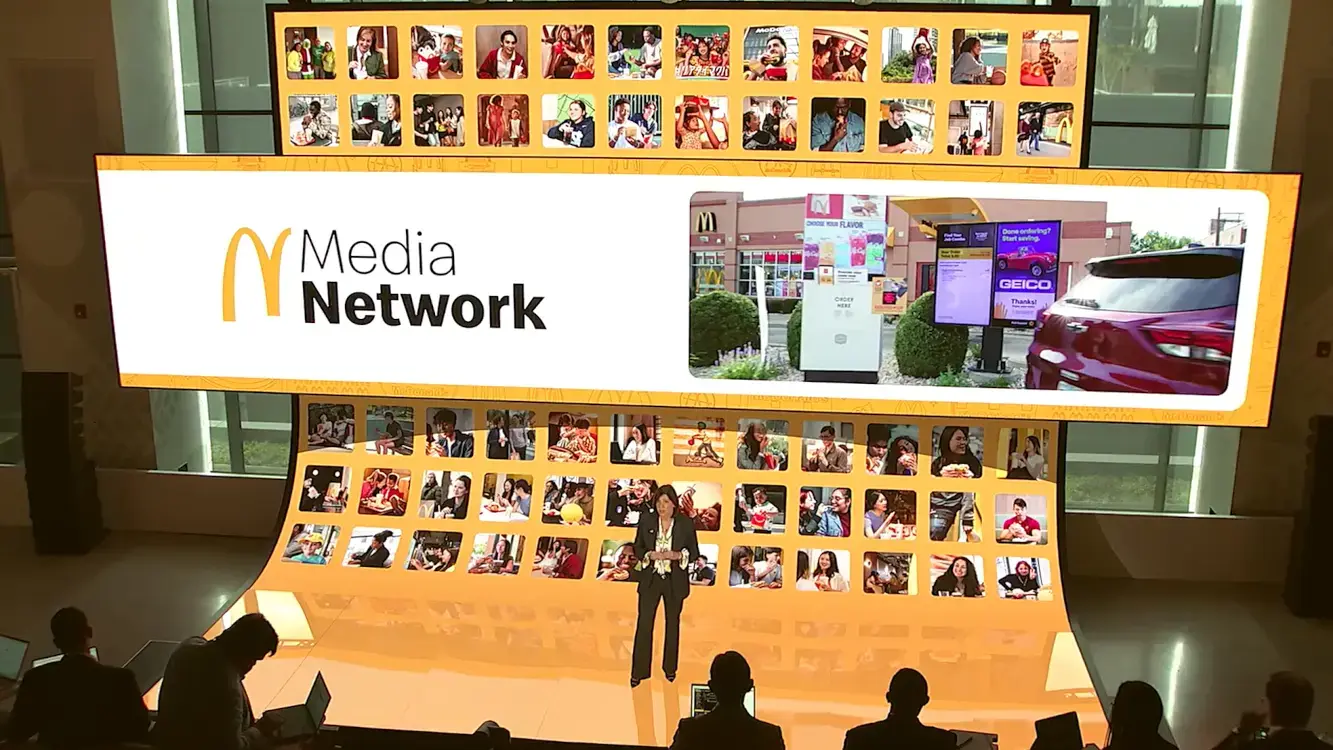
When we talk about media, we usually think of broadcasters, news portals and social networks. But one of the stories that shook the digital signage market in recent days came from a burger chain. At its 2026 Investor Day in Chicago, McDonald's presented a strategy that combines AI-powered operations, digital customer engagement and a new commerce media business.
Invidis's coverage, written by Florian Rotberg, sums up the message well: what is really changing is not the menu. It is what happens behind the counter and across the growing network of digital touchpoints the brand controls. In this article, we break down the numbers, explain each piece of the strategy and offer a perspective for media operators.
The asset: a huge physical network with data in hand
The starting point is simple. McDonald's has one of the largest physical retail networks in the world and now wants to monetize that presence in new ways. Screens, loyalty data and customer interactions come together to form a commerce media platform.
Two numbers give the thesis its strength. The first is the base of nearly 220 million loyalty program members. The second is the flow of about 70 million visits per day. Together, they create one of the largest consumer engagement platforms in the food service industry.
Notice what this means in practice. An advertiser in commerce media is not buying just space. They are buying the chance to reach a person at the moment of purchase, backed by real behavioral data. That is why this segment has become one of the most contested growth areas in retail.
The screen stops being a digital menu and becomes business infrastructure.
The target: a media business worth over US$ 1 billion
McDonald's wants to build, over time, a media operation capable of generating more than US$ 1 billion in annual revenue. It is not a deadline, it is a horizon. Even so, the figure shows the level of ambition: the company does not want a side advertising project, it wants a meaningful revenue line.
Testing has already started. Today, commerce media pilots run in around 450 restaurants in the United States, with ads appearing on drive-thru ordering screens. The market expectation, according to Invidis, is that the network will expand to other touchpoints: digital menu boards, self-order kiosks and the McDonald's app.
The drive-thru already carries ads in testing. The other channels are natural extensions pointed out by the coverage.
Source: Invidis (09/27/2026). "Likely" is the market's expectation, not an official announcement.
The pilot's scale: it is only the beginning
An important detail, so we do not get carried away. The 450 test restaurants represent about 1% of the global network (450 out of more than 46,000). In other words, McDonald's media business is still early in the curve, and the US$ 1 billion target depends on a long expansion.
The proportion shows how much road is still ahead.
Our own calculation based on Invidis's numbers (450 test restaurants; more than 46,000 in total). The blue strip was slightly enlarged to stay visible.
Digital becomes the main sales channel
To sell media inside the restaurant, the customer journey has to run through screens and systems. And that is exactly what is happening. In China, about 98% of transactions already happen through digital channels. Other markets have not reached that level yet, but they are moving in the same direction.
Digital ordering, loyalty programs, mobile payments, kiosks and drive-thru technology are becoming central pieces of the experience. And every transaction that moves to digital opens room for three things at once: personalizing offers, optimizing prices and generating advertising revenue.
A picture of what McDonald's expects to see in other markets over the years.
Source: Invidis (09/27/2026), based on McDonald's Investor Day.
AI at the edge: ArchIQ, engagement and pricing engines
On the operations side, McDonald's is also investing heavily in artificial intelligence. The company has developed two systems that work with data and automation in real time:
- Customer Engagement Engine: optimizes customer interactions to improve restaurant performance.
- Menu Pricing Engine: supports menu and price management, also focused on revenue.
The latest step is ArchIQ, an AI-powered restaurant operating system designed to bring intelligence closer to the restaurant floor. Working with Google, the chain is deploying edge AI capabilities across its US restaurants, enabling faster data processing and more responsive operations.
Another milestone stands out. After years of regional technology variations, McDonald's is moving toward a single point-of-sale platform across all restaurants worldwide. For anyone who works with data, that is gold: one unified system means standardized data, and standardized data is the foundation for selling media with credibility.
Archy: voice ordering at scale
One of the most visible innovations is Archy, the AI voice ordering system used in the drive-thru. It is currently available in English and Spanish in the US and, according to the reported numbers, reaches more than 90% order accuracy.
Besides making service more consistent, the automation reduces labor needs by about 50 hours per restaurant per week. A simple calculation puts that at around 2,600 hours per restaurant over a year. Multiplied across a network this size, it is easy to see why operations and media go hand in hand: the same ecosystem of screens and systems that gains efficiency also opens space for ads.
Reported results of the voice ordering system in US drive-thrus.
Source: Invidis (09/27/2026). The bars use different scales and serve only as a visual aid. Languages: English and Spanish.
McDonald's Next: new restaurants, the usual pace
The transformation also reaches restaurant design. Under the McDonald's Next initiative, the company is introducing updated architecture concepts and new digital signage experiences built to support an omnichannel journey.
But mind the timeline. Like most major chains, McDonald's rolls out market by market, and restaurant remodeling cycles often stretch across ten years or more. Do not expect a global switch overnight. It is a long-term change, built in layers.
Four angles of the stage built at McDonald's headquarters in Chicago.
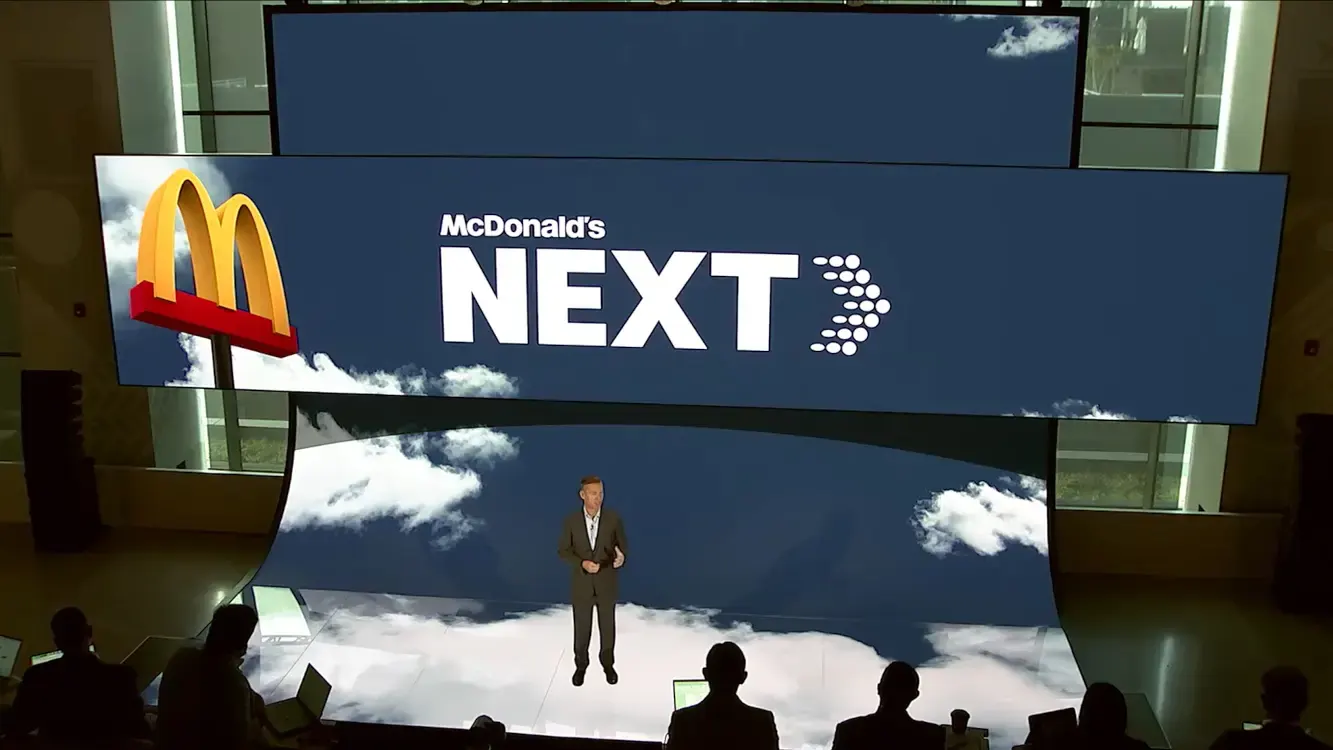
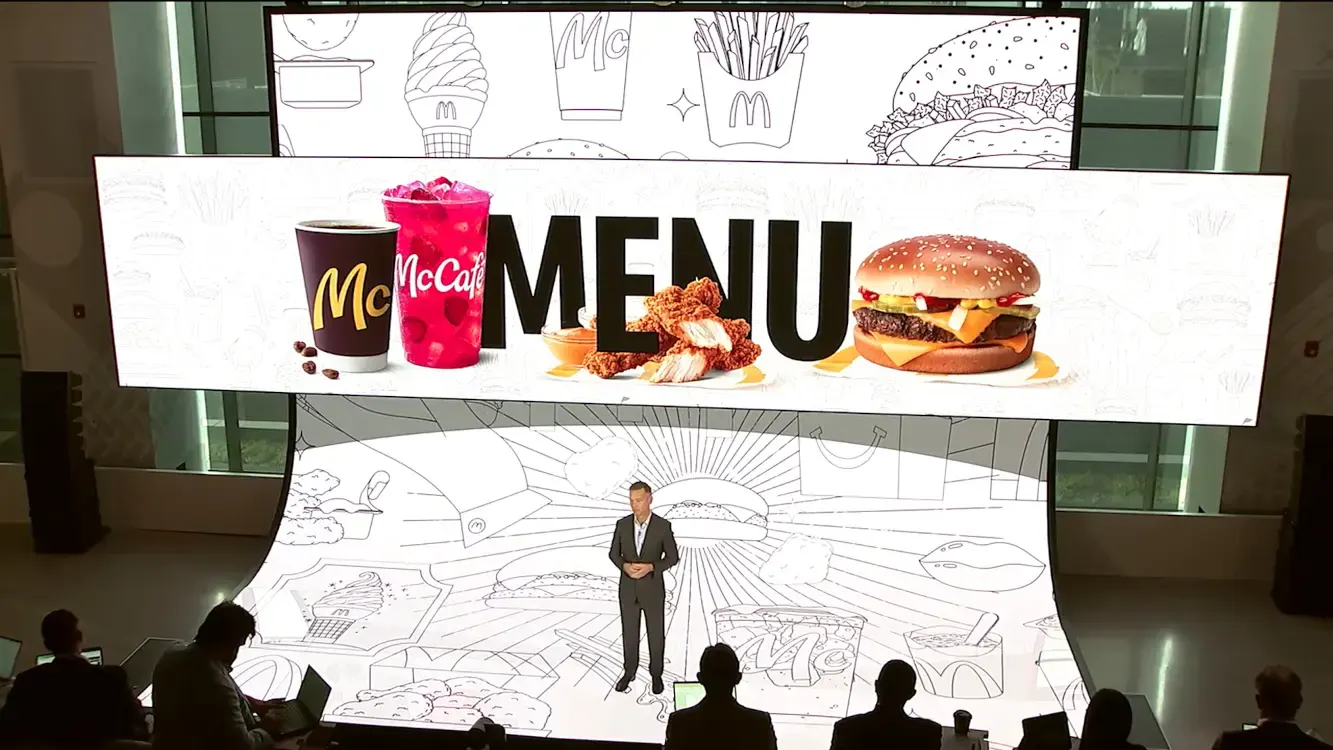
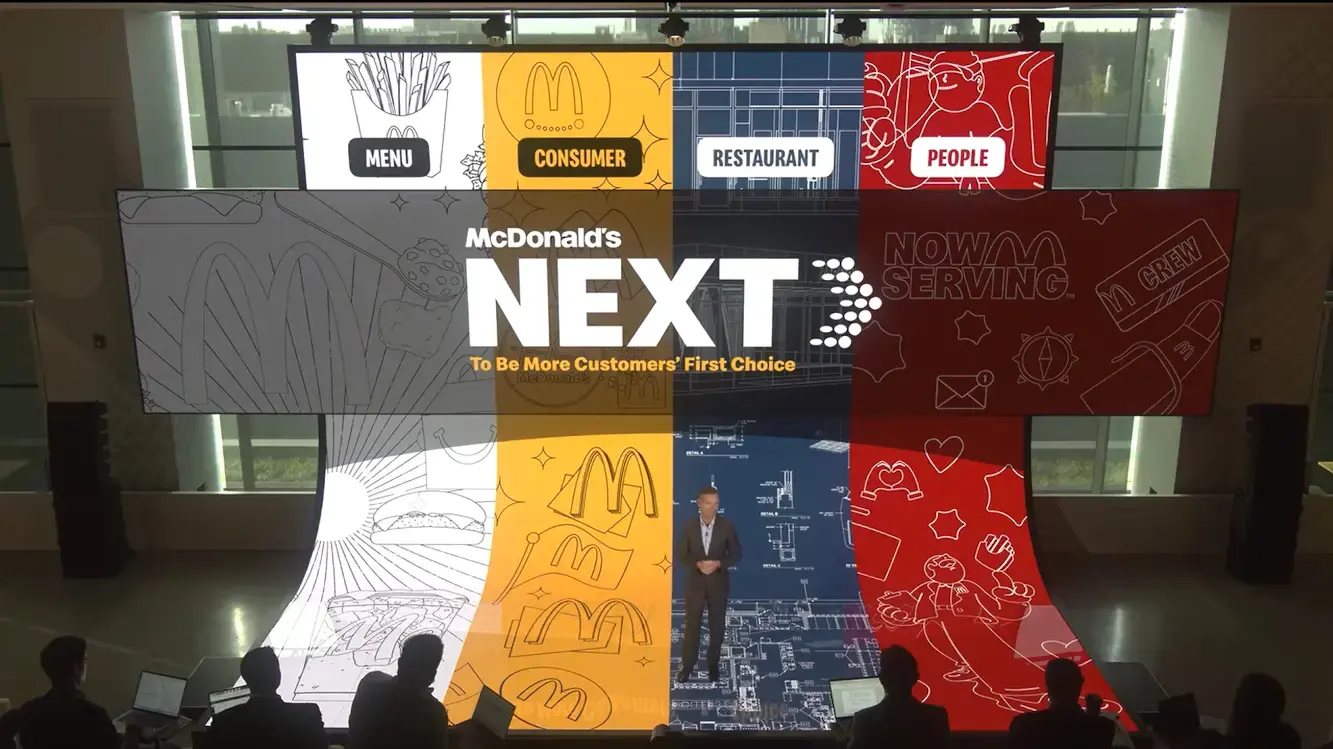
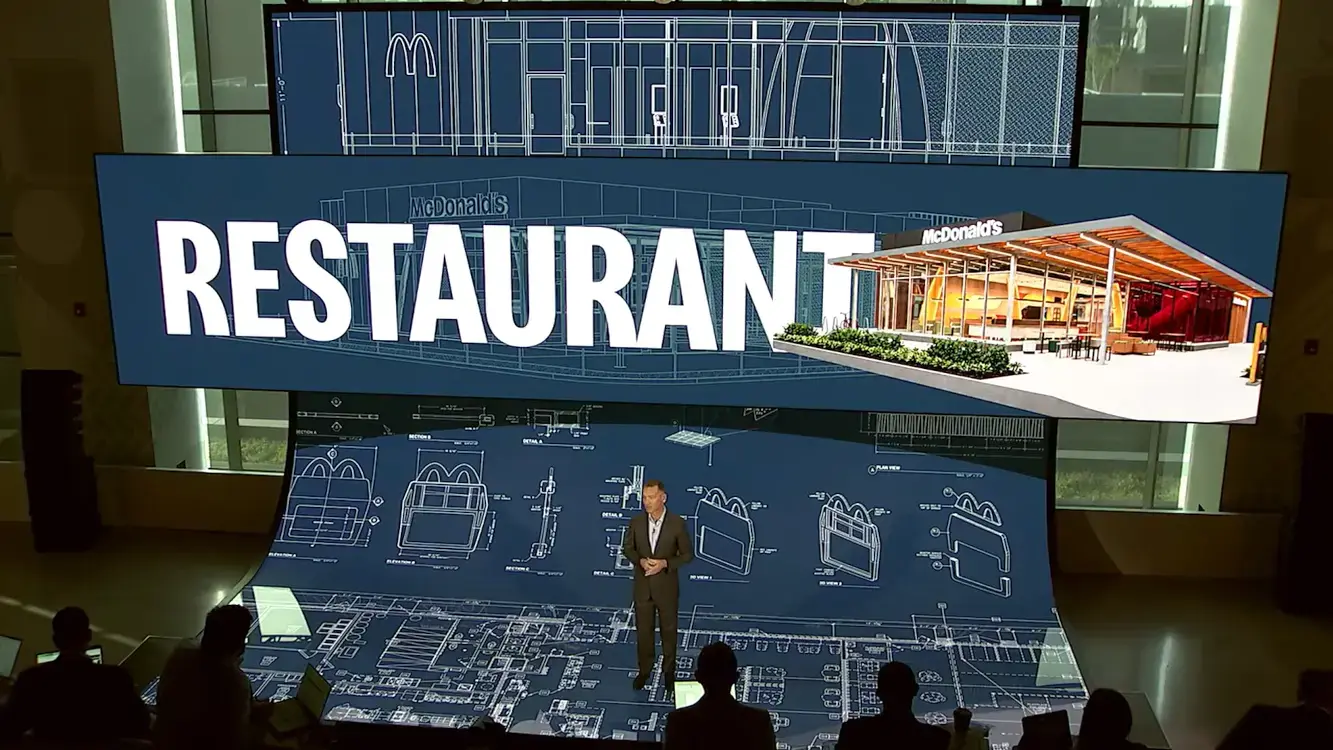
Images: McDonald's 2026 Investor Day, via Invidis.
The lesson for digital signage: the screen is infrastructure
The central point of Invidis's coverage is this: at McDonald's, screens stop being a supporting item and become the center of the business model. They support engagement, AI-driven operations, dynamic pricing, loyalty and, more and more, media monetization.
Instead of a screen that only shows the menu, the chain now has screens that help sell, make operations more efficient and generate advertising revenue at the same time. Every screen plays three roles at once.
What DOOH operators can take from this
This part is our own reading, not a fact from the original article. But we believe it makes sense for anyone operating digital out-of-home media, whether with elevator screens, street panels, indoor media or in-store networks.
- Data is what sets media apart from space. McDonald's is not selling just screens. It is selling screens with context, audience and results. Operators who organize their inventory, schedules and playback data well are a step ahead.
- Standardization sells. The chain wants a single point of sale precisely because scattered data does not become a media product. For an operator, the equivalent is having inventory, contracts and proof of play in one place.
- Proof of results is the new standard. The more retail becomes media, the more advertisers expect similar measurement from any channel, DOOH included.
- Scale is built in stages. A pilot in about 1% of the network and ten-year cycles show that nobody builds this kind of operation at once. Starting small and measuring is the way.
- The media competitor has changed. When retail and food chains become media sellers, they start competing for budget with traditional OOH. Positioning with data, reach and proof is what sustains price.
Quick questions
What is commerce media?
It is the sale of advertising inside the environment where the purchase happens, using the retailer's own data. In McDonald's case, that includes drive-thru screens, kiosks, menu boards and the app, backed by loyalty data.
How much does McDonald's expect to earn from media?
The target is to build, over time, a business capable of generating more than US$ 1 billion a year in revenue. The coverage does not mention a deadline.
How many restaurants is media already running in?
Tests are happening in around 450 restaurants in the United States, with ads on drive-thru ordering screens.
What is ArchIQ?
It is an AI-powered restaurant operating system built to bring intelligence closer to operations. Working with Google, it uses edge AI in US restaurants.
Where Hivestr comes in
Hivestr is an ERP/CRM built for OOH and DOOH media operators, developed by people who also operate outdoor media. Inventory, proposals, contracts, proof of play and finance live in the same system, which lets operators talk to agencies and advertisers on equal footing, whether they are a large network or a regional company.
Subscribe to Hivestr and organize your media operation
Inventory, proposals, insertion orders, proof of play and finance in one place. Start with a 7-day free trial, no commitment.
Subscribe to HivestrSource: Florian Rotberg, "QSR: Why McDonald's Is Becoming a Media Company", Invidis, September 27, 2026. invidis.com. The proportion and annual hours calculations are simple estimates based on the article's numbers. The section for operators is Hivestr's editorial analysis.
Your media company's whole operation
Inventory, proposals with online approval, CRM, campaigns, proof of posting and finance in one account. 7 days free to try.
Subscribe to the Hivestr newsletter
Get tips, OOH/DOOH industry news, and Hivestr content straight to your inbox.