
What will an out-of-home company look like in 2030?
An ordinary Tuesday at a mid-sized media owner, told minute by minute. What in that scene already exists today, what never changes, and what decides who gets there.
· Hivestr · 33 views
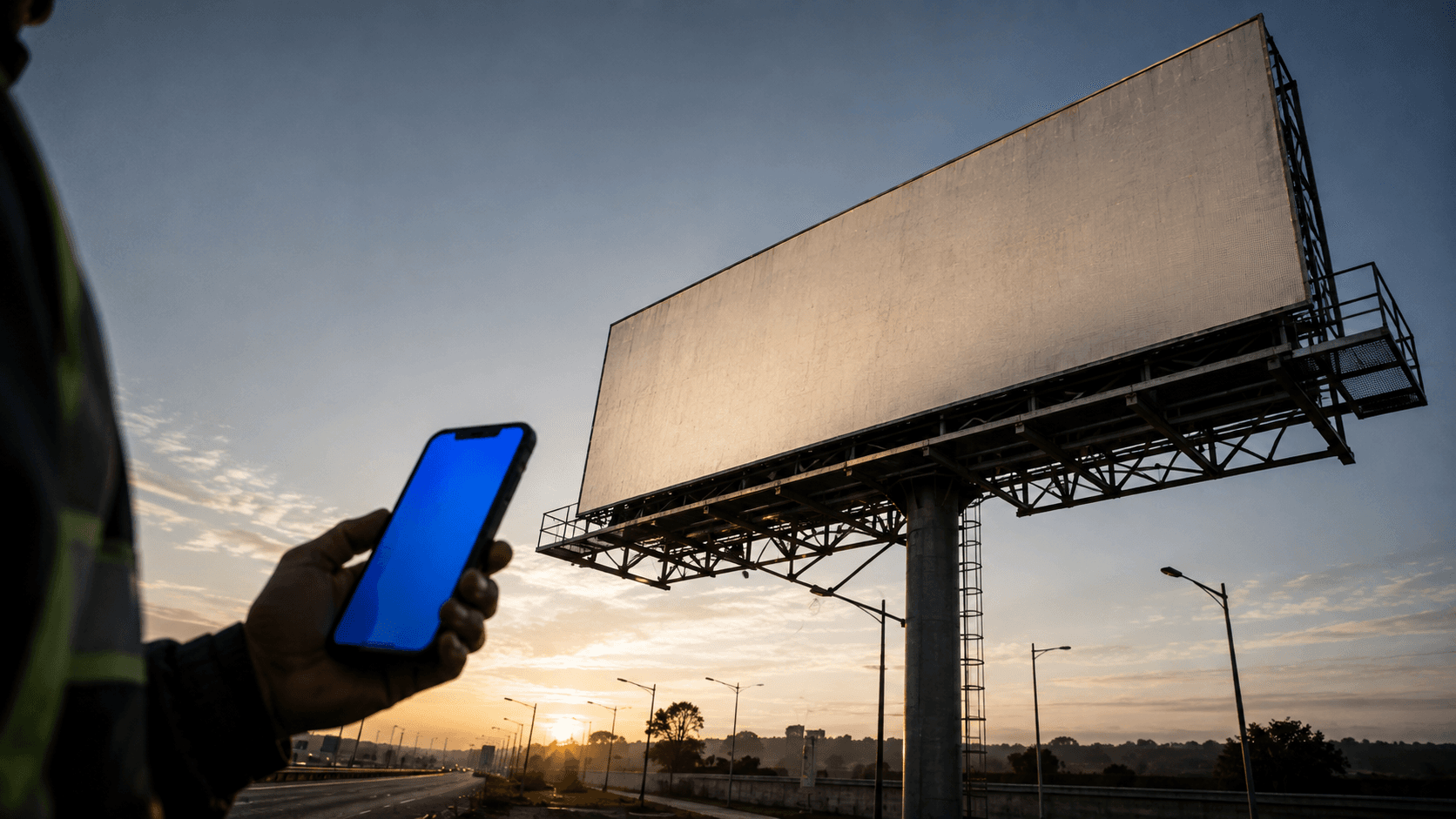
Predictions about out-of-home usually get made with abstract nouns. Integration, ecosystem, digital transformation, omnichannel journey. Words that describe nothing anyone can recognize in their own working day.
So let us do it differently. Instead of listing trends, we will describe an ordinary Tuesday at a mid-sized out-of-home media owner in 2030. A company with 180 faces across static and digital, four markets, twelve employees.
After the scene, we will separate what is reasonable from what is optimism, and look hard at what will not change at all.
What happened there that does not happen today
It is worth rereading the scene looking for what is absent rather than what is present.
Between 9:12 and 10:05, nearly an hour of plan-building work, nobody at the media owner did anything. No spreadsheet checking, no manual site selection, no document assembly, no file sending. The agency worked alone inside an inventory that answered for itself.
The first moment an employee appears in the story is at 10:40, and he appears to do the one thing nobody can automate: negotiate using knowledge that is not in the system. He knows two sites will come free earlier. That is written nowhere. It is in his head.
After that, every stage consumes the record created by the one before it. The print order reads the dimensions from the site record. The run sheet reads the address. The proof reads the face. Finance reads the contract. No data is entered twice, because no data needs to be carried from one place to another by a person.
Nothing in that scene is science fiction
Here is the point that tends to surprise people reading this kind of description. Every individual link in that story already exists and already works somewhere in the world, today, in 2026.
| Link in the scene | Exists already? | What is missing |
|---|---|---|
| Automated inventory query | Yes | A standardized record on the media owner's side |
| Real time availability | Yes | A single source of truth, with no parallel spreadsheet |
| Rule-based pricing | Yes | A written pricing policy instead of an improvised one |
| Plan built by the buyer | Yes | Inventory exposed in a browsable form |
| Proof with date and coordinates | Yes | Field discipline, not technology |
| Advertiser tracking dashboard | Yes | Campaign data living in one place |
Read the middle column top to bottom. Not one row says something still needs inventing. What does not exist today, and what the 2030 scene actually describes, is those six links connected inside one company, with no person manually bridging the gap between each of them.
2030 is not a technology date. It is an adoption date. The question is not when these tools will exist, because they already do. It is when enough media owners will have their own inventory in a condition to use them.
What does not change by 2030
A vision piece that only describes improvement is advertising. It is worth being specific about what stays exactly the same, because the list is longer than the enthusiasm suggests.
- Somebody climbs the structure. The vinyl gets changed by a person, on a ladder, in the sun, and that is not changing in four years.
- City hall is still city hall. Permits, sign codes, renewals and inspections keep moving at the pace of local government.
- The lease with the property owner. Negotiated in conversation, renewed on trust, lost when somebody offers more.
- The weather. Wind, storms and sun degrade exposed physical material, and no software solves that.
- The relationship with the agency. Automating the request does not replace twenty years of history between two people who trust each other.
- Local knowledge. Knowing which avenue changes traffic pattern in harvest season stays the most valuable and least digitizable thing in the business.
- Prospecting new sites. Finding, negotiating and permitting a good address is still work done on foot.
Notice that this list is precisely the core of the out-of-home business. What automation absorbs is the administrative layer around it, which today takes up most of the working day for nearly everyone in the company.
Where the freed-up time goes
The question every media owner asks on reading a scene like this is whether it means laying people off. The honest answer is probably not, but it does mean changing what people do.
Half the day is logistics
Checking availability, picking sites, hunting for a photo, assembling a document, exporting, sending, chasing a reply, redoing it with two sites swapped. Whatever time is left goes to selling.
The whole day is relationship
Understanding the advertiser's problem, proposing what the system would not propose, negotiating exceptions, prospecting clients who never bought out-of-home, tending the book. The system handles logistics.
There is an interesting side effect here. The tasks left to people are exactly the ones that were always neglected for lack of time: record quality, relationships with property owners, local audience knowledge, prospecting new addresses.
Those are, not coincidentally, the four things that determine the long-term value of an out-of-home business. Automation does not redefine what is valuable in this industry. It gives time back to what was always valuable and never fit in the calendar.
The question that decides who gets there
If the technology already exists and what is missing is adoption, then the deciding variable is not budget or technical sophistication. It is something simpler and considerably more uncomfortable.
The entire 2030 scene rests on one condition at the source: that the company's inventory is reliable, machine-readable data. If the availability at 9:14 is wrong, the eleven stages that follow inherit the error, and the result is worse than the manual process, because now the error travels faster and reaches more people.
There is no route to that scene that begins with buying technology. It begins with fixing the records and the occupancy data. A company with organized inventory can adopt any tool in weeks. A company running on spreadsheets can adopt none of them, however much it spends.
This is why the gap between media owners will widen before it narrows. The first two steps, standardized records and a single source of availability, cost almost nothing and depend on nobody outside the company. But they require a decision nobody is obliged to make, and one that shows no visible result in the first month.
What you can start this week
None of this needs a four-year project. The first three things fit into next month and each pays off on its own, even if the 2030 scene never reaches your market.
A complete record per face
Coordinates, format, exact dimensions, illumination, minimum period, current photo. It is what feeds the plan, the print order, the run sheet and the proof later on.
One source of availability
If two people can give different answers about the same face, this is where the chain breaks.
A written pricing rule
Season, lead time and flight length as known percentages, rather than a decision made fresh in every negotiation.
Notice that none of the three steps mentions artificial intelligence, marketplaces or programmatic. They are the foundation any of those things can be installed on later, and pointless to install before.
The 2030 out-of-home company already exists today
It is not bigger than today's. It does not necessarily have more faces, more staff, or technology that has yet to be invented.
The difference is that inside it, the inventory stopped being a file somebody updates and became an infrastructure that answers. Everything else in the scene, the agency building the plan alone, the price adjusting, the printer receiving the right dimensions, the advertiser seeing the photo two hours later, follows from that.
It is still a company of people who climb structures, negotiate with property owners, deal with city hall and know their own market better than any database. That part does not change, and it is good that it does not, because it is the part nobody can copy.
What changes is that those people stop spending half the day being the connecting cable between one system and another. The 2030 out-of-home company is not a more technological company. It is one where people went back to doing the work only they can do.
Built for the media owner who wants to get there.
Hivestr is a management platform built exclusively for OOH, DOOH, TV and radio media owners. Geolocated inventory, occupancy control, proposals, media kit and proof of posting in one place. Not because technology is the point, but because the foundation has to exist before anything else can.
Explore Hivestr →Your media company's whole operation
Inventory, proposals with online approval, CRM, campaigns, proof of posting and finance in one account. 7 days free to try.
Subscribe to the Hivestr newsletter
Get tips, OOH/DOOH industry news, and Hivestr content straight to your inbox.