
What the City Says When You Stop Looking at Your Screen
On attention, presence, and why OOH captures something digital will never replicate.
· Hivestr · 85 views
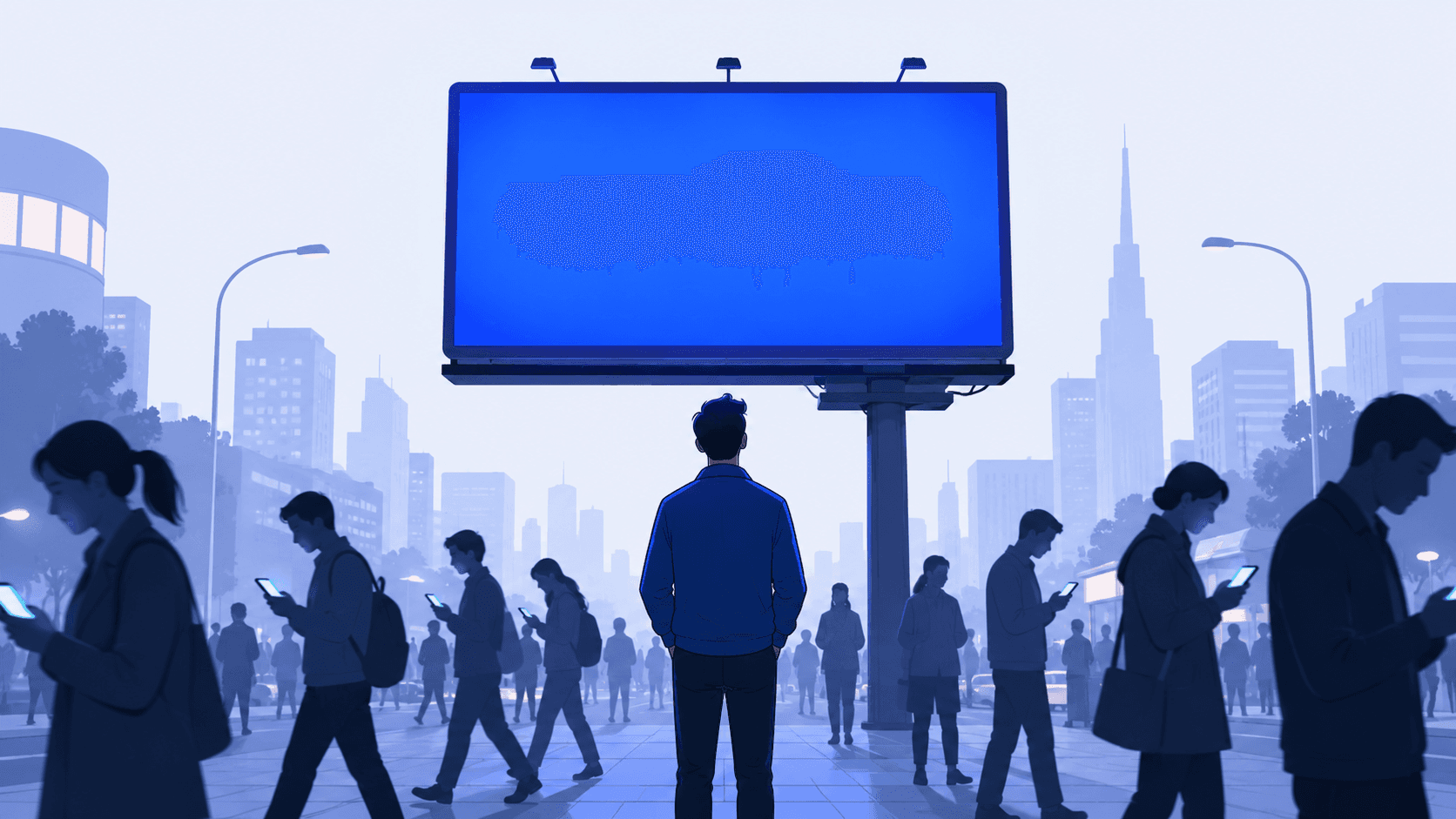
What the City Says When You Stop Looking at Your Screen
There's an experiment you can run right now. No lab required, no app to download, nothing but walking two blocks without looking at your phone.
Just two blocks. Eyes on the street.
What you'll find will seem too obvious to be called a discovery. But it's exactly that obviousness the industry spent years trying to ignore while chasing the next digital format that was going to "change everything."
You'll find the city. And the city has a lot to say.
The attention nobody borrowed
There's something digital will never replicate — no matter how advanced the algorithms get, no matter how precise the targeting becomes, no matter how far the retargeting follows you across the internet.
Digital asks for attention. It competes for it. It shouts, flashes, notifies, interrupts, runs the countdown on the discount that expires in twelve minutes. It begs you to look.
The billboard doesn't ask for anything. It's just there. And you look because you chose to.
That changes everything about how the message lands.
When you're on your phone, your attention is split between the content you went looking for and the ad that intruded. There's tension. Resistance. The brain developed antibodies against the banner, the pre-roll, the sponsored story that appears between one friend and the next. We learned, collectively, not to see what we don't want to see — even when it's right in front of our eyes.
On the street, there's no filter. You lift your gaze and the billboard is there. Nobody paid to interrupt your favorite content. Nobody invaded anything. It happened naturally, the way you stop for two seconds when you see a flowering tree in the middle of the sidewalk just because it's beautiful.
The city as it really is
When you stop looking at your screen, you notice the city is an entire medium of communication on its own.
It has texture. Sound. Smell. Rhythm. That corner everyone in the neighborhood knows without ever having agreed on a meeting point. The bank billboard that became famous for the bad joke that somehow worked. The supermarket facade that never changes its banner and has become part of the landscape — almost an institution.
The city has memory. And outdoor media is one of the few advertising formats that genuinely participates in that memory.
Ask anyone over forty which billboard they remember most. They'll remember. They'll remember where they were, which highway, which city, what they were doing in the back seat of the car when that line came through the window and got lodged somewhere in childhood.
No banner from 2009 did that.
The body the screen forgot
There's something digital completely neglected over the last two decades: the human body exists outside the screen.
We move. We go to places. We have physical routines that repeat — the same commute to work, the same gas station, the same traffic light that always turns red at the wrong moment. We're creatures of geographic habit, and outdoor media understands that habit better than any behavioral data platform ever could.
A well-placed billboard doesn't need a cookie. It already knows you'll pass by tomorrow. And the day after. And next week. It waits. With the patience of something certain.
The frequency of exposure digital tries to manufacture through retargeting — outdoor delivers organically, day after day, simply by existing on the route you already take.
Outdoor knows where you are.
What happens when you uninstall
Picture a Friday afternoon in any mid-size city. The commercial district is busy. The main avenue is gridlocked. The sidewalks have movement.
In that moment, how many people have their phones in standby mode in their pocket — because they're driving, because they're carrying bags, because they're holding someone's hand, because they're simply existing in physical space with their full attention available?
Many. Most.
And in that moment, the only medium reaching them is the one on the street.
There's no way to install an ad blocker for a billboard. No way to put the panel on silent. No way to skip after five seconds. The city doesn't have a close button.
The question the industry avoided
For years, the advertising world asked the wrong question. The question was: "will digital kill outdoor?"
The right question was: "what does outdoor do that digital can't?"
And the answer, looking back with the clarity that time gives, is simple: outdoor inhabits the real world. It exists in the same space as people, the same air, under the same sun, on the same corner where life actually happens.
Digital exists on a screen. And the screen, however omnipresent, is still a window. You look into it. The billboard isn't a window — it's outside, on the same plane as you, part of the scenery you move through every day.
That's not nostalgia. It's physics.
What the city says, after all
Back to the experiment. Two blocks without your phone.
The city speaks of movement and stillness. Of urgency and permanence. It speaks to everyone at once, without segmenting, without filtering, without an algorithm deciding who deserves to see what.
It speaks to the delivery driver, the executive, the student, the woman who goes to the pharmacy every morning at the same time. It speaks to people who will never download an app, never accept cookies, never click "learn more."
And when the right message appears in the right place, at the moment when someone lifts their gaze — something happens that no performance platform has managed to reproduce yet.
Real presence happens. Genuine contact. That fraction of a second when a brand enters someone's life not because an algorithm decided, but because the city allowed it.
And that, my friend, has no CPM that measures it right.
Outdoor is simply there when you arrive.
FOR THOSE WHO BELIEVE IN THE STREET
Give your operation the structure outdoor deserves
Hivestr is the ERP built by people who understand OOH, for people who live by OOH. Inventory, proposals, campaigns, and billing in one place.
Discover Hivestr →Your media company's whole operation
Inventory, proposals with online approval, CRM, campaigns, proof of posting and finance in one account. 7 days free to try.
Subscribe to the Hivestr newsletter
Get tips, OOH/DOOH industry news, and Hivestr content straight to your inbox.