
What is OOH and DOOH: the definitive guide to outdoor advertising
What OOH means, how it differs from DOOH, the formats, how it's bought, how it's measured, and why it's the fastest-growing advertising channel. Everything you need to know about out-of-home media.
· Hivestr · 148 views
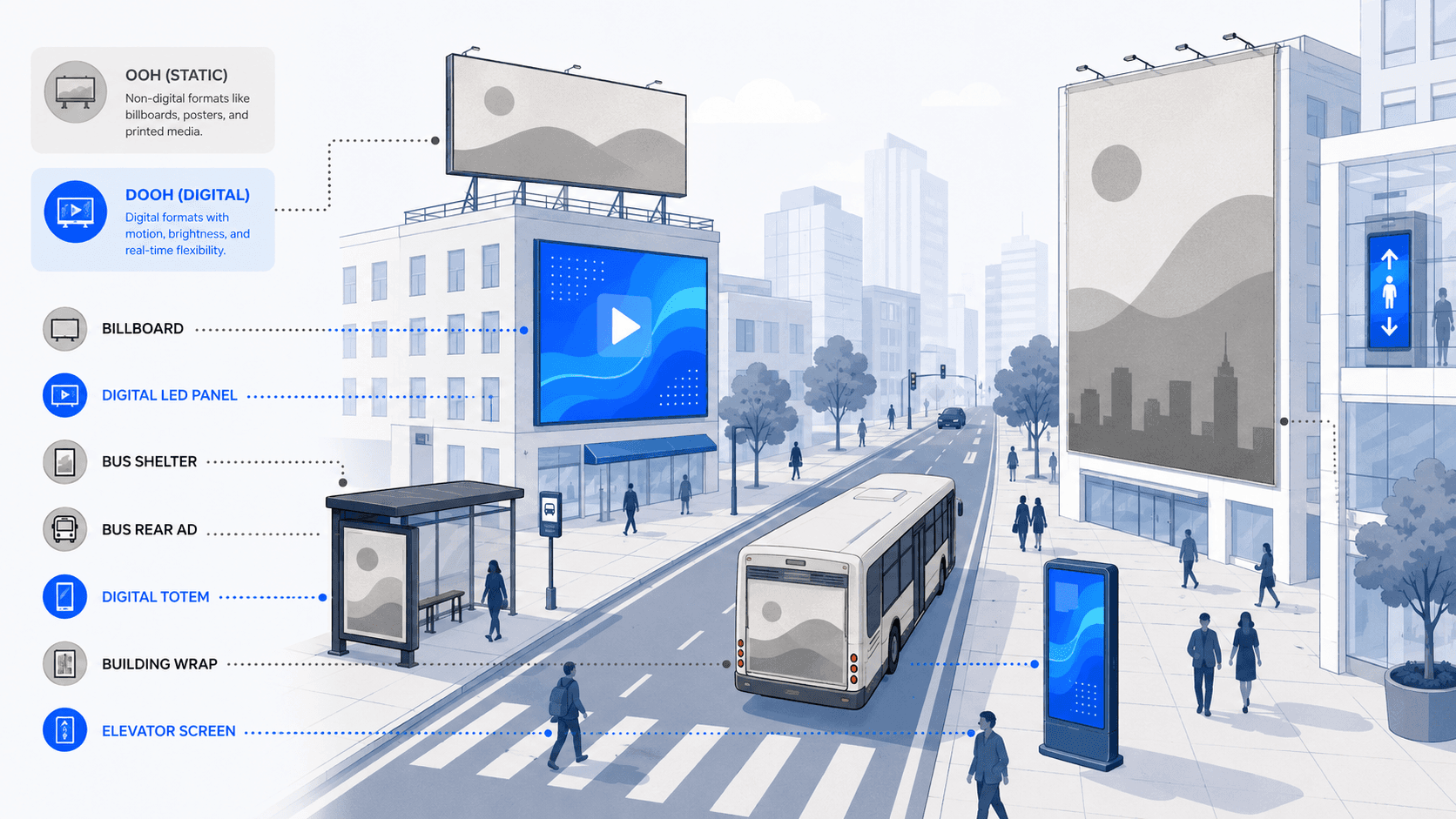
OOH stands for Out of Home — any form of advertising that reaches consumers when they're outside their homes. Billboards, LED panels, bus ads, street clocks, building wraps, elevator screens, mall kiosks: all OOH. DOOH (Digital Out of Home) is the digital segment — screens displaying dynamic, programmable content that can increasingly be bought programmatically, just like online media.
In Brazil, OOH is the 3rd largest advertising channel, behind only TV and internet. In 2025, the sector generated R$3.5 billion in agency-intermediated investments (12.1% of total ad spend, per CENP-Meios) and R$5.5 billion across the full value chain. In Q1 2026, OOH grew 48.6% year-over-year — nearly 3x faster than the ad market overall. It reaches 89% of the Brazilian population (Kantar), outperforming Latin America (83%), Spain (76%), Germany (69%), the UK (65%), and France (62%).
- Definition: what OOH and DOOH mean
- OOH vs. DOOH: the essential difference
- Outdoor advertising formats
- Metrics: how OOH is measured
- How outdoor advertising is bought
- Who operates: media owners, agencies, advertisers
- The OOH market in numbers
- What's changing: 2026 trends
Definition: what OOH and DOOH mean
OOH (Out of Home) is any form of advertising that reaches the public when they're outside their home — on streets, in transit, at stations, airports, malls, elevators, and other circulation spaces. It includes static formats (printed posters, vinyl, painted walls) and digital formats (LED screens, programmatic panels). Known as "mídia exterior" in Brazil and "publicidad exterior" in Latin America.
DOOH (Digital Out of Home) is the OOH segment that uses digital screens. The fundamental difference: in traditional OOH, the creative is physical and changed manually. In DOOH, content is electronic, can change in seconds, be scheduled by time, segmented by location, and in many cases bought programmatically — the same way digital media is purchased.
OOH vs. DOOH: the essential difference
| Feature | Static OOH | DOOH (Digital) |
|---|---|---|
| Creative | Vinyl, poster, painted | Content displayed on LED/LCD screen |
| Content change | Manual (physical installation) | Remote, instant, programmable |
| Campaign duration | Bi-weekly (14 days) or monthly | By second, hour, day, or campaign |
| Advertisers per unit | 1 at a time | Multiple in rotation (playlist) |
| Buying | Direct with media owner or via agency | Direct, agency, or programmatic (DSP/SSP) |
| Measurement | Traffic estimates, OTS | Impressions, dwell time, camera data, proof-of-play |
| Cost | Generally lower per point | Higher, but split among advertisers |
| Examples | Billboard, backlit panel, building wrap | LED panel, digital kiosk, elevator screen |
Outdoor advertising formats
Large formats
Billboard
Rectangular panel, typically large-scale in high-traffic urban areas. Can be static (vinyl) or digital (LED). The most traditional OOH format worldwide.
Frontlit and backlit panels
Illuminated panels — frontlit has external lighting; backlit is translucent and lit from behind. Superior nighttime visibility.
Building wraps
Advertising installed on building facades, covering multiple floors. Massive visual impact in dense urban centers.
LED panels
Large-format digital screens. The core of DOOH in major cities. Enables video, dynamic content, multiple advertisers in rotation, and programmatic buying.
Street furniture
Street furniture (MUB)
Bus shelters, street clocks, benches, bike racks with advertising faces. Integrated into the urban landscape. Leads OOH investment in Brazil, accounting for nearly half of total spend.
Kiosks / totems
Vertical structures with advertising faces, digital or static. Common on sidewalks and city entrances. Growing in interactive digital versions.
Transit
Bus advertising
Ads on the rear, sides, or interior of buses. Itinerant format — the vehicle carries the message across the city. High coverage at low cost.
Station and airport media
Panels in metro stations, bus terminals, and airports. Captive audience with high dwell time — people are waiting, not passing.
Indoor and retail
Elevator and mall screens
Digital screens in enclosed high-traffic spaces. Captive audience for seconds to minutes.
Retail media OOH
Screens at point of sale — supermarkets, pharmacies, stores. Impacts consumers at the purchase decision moment.
Metrics: how OOH is measured
- Impressions (impacts). Number of times the ad was potentially seen. In static, estimated by traffic flow. In DOOH with cameras (like Datavisiooh), measured in real time.
- OTS (Opportunity to See). Number of times a person in the target audience had opportunity to see the campaign. Base for frequency calculation.
- GRP (Gross Rating Points). Reach × frequency. Metric inherited from TV. Used to compare OOH with other media in planning.
- CPM (Cost per Thousand Impressions). How much it costs for the ad to be seen 1,000 times. Enables direct comparison with digital and TV.
- Reach. Percentage of the population or target audience exposed at least once.
- Frequency. Average number of times each exposed person saw the campaign.
- Dwell time. Average time a person is exposed to the message. Measured by cameras and sensors. Premium panels achieve up to 5x the global average of 27 seconds.
- Proof-of-play / proof-of-posting. Verification that the campaign ran (DOOH) or was installed (static). In DOOH it's automatic; in static, done through photographic proof.
How outdoor advertising is bought
Direct with the media owner
Advertiser or agency contacts the media owner (company operating the panels), negotiates points, period, and price. Most common model, especially for static OOH and regional operators.
Via advertising agency or media central
Agency plans the campaign, selects formats and markets, negotiates with multiple media owners. Common in national campaigns involving dozens of cities.
Programmatic buying (DOOH)
Works like digital media: advertiser uses a DSP to buy impressions on digital screens connected to SSPs. Automated, segmented, adjustable in real time. Still under 10% of total in Brazil, but growing fast.
Via marketplace
Platforms connecting media owners and buyers. Agency searches available inventory, selects, and buys digitally. Some marketplaces (like Hivestr's) integrate the sale to the media owner's ERP automatically.
The OOH market in numbers
United States
Billboards dominate
74.5% of US OOH revenue came from large-format ads in Q1 2025. Billboards remain the backbone of the industry. Transit was the fastest-growing segment at +9.2% YoY.
Tech brands fuel growth
Technology and digital-native brands accounted for 28% of the top 100 OOH advertisers in 2025 — including Apple (#1), Amazon, Netflix, Google, Uber, DoorDash, Meta, and OpenAI (OAAA).
Programmatic DOOH rising
Programmatic DOOH ad spending is projected to reach $1.35 billion by 2026 (eMarketer). 80% of consumers are likely to take action after seeing a creative or engaging OOH ad.
70% increased spend
70% of the top 100 OOH advertisers increased spending compared to 2024. Legal services, financial services, communications, and insurance all posted double-digit growth (OAAA).
Brazil
In Brazil, OOH is the 3rd largest advertising channel. Revenue reached R$3.5 billion in 2025 (12.1% of total ad spend, CENP-Meios). The sector grew 48.6% in Q1 2026 vs. Q1 2025 — nearly 3x faster than the overall ad market. OOH reaches 89% of the Brazilian population (Kantar), outperforming the LATAM average of 83%. The full OOH value chain generated R$5.5 billion in 2024 (ABOOH/Central de Outdoor/Fenapex).
Global outlook
By 2029, Statista projects 44% of global OOH ad spend will go to digital screens. DOOH is expected to grow at a 7.6% CAGR over the next four years, while traditional OOH grows at 0.7%. The shift to digital is structural, not cyclical — and it's happening across every major market.
What's changing: 2026 trends
- Accelerated digitization. In 2023, 66% of Brazilian consumers noticed digital OOH ads — up 14% in six years (Kantar). The DOOH share grows yearly.
- Camera and IoT measurement. Platforms like Datavisiooh install cameras on panels and capture real impressions, dwell time, and audience profile with AI. Combined with ERPs like Hivestr, this data flows directly into proposals.
- Programmatic DOOH. Automated screen buying via DSP/SSP. Still under 10% in Brazil, but growing. Enables OOH buying with digital logic — segmentation, dynamic budget, real-time optimization.
- Interactive proposals and data-driven sales. The era of PDFs with point photos and traffic estimates is ending. Shareable links with live audience data and online approval are changing how OOH is sold.
- Retail media OOH. Point-of-sale screens converging with outdoor. Impacts consumers at the purchase moment.
- Sustainability. Solar-powered panels, eco-friendly inks, recyclable materials. OOH faces the same ESG pressure as other media.
From interactive proposal to cash — all in one platform.
Hivestr manages inventory (OOH + DOOH + TV + radio), CRM, interactive proposals with Datavisiooh audience data, proof, finance with invoicing, media kit, embeddable map, and agency marketplace. From R$97/month. Free trial for 7 days.
Try Hivestr · 7 days free →Your media company's whole operation
Inventory, proposals with online approval, CRM, campaigns, proof of posting and finance in one account. 7 days free to try.
Subscribe to the Hivestr newsletter
Get tips, OOH/DOOH industry news, and Hivestr content straight to your inbox.