
The Attention Problem Digital Has That OOH Solved 100 Years Ago
Every digital impression is exposed to bots, ad blockers and skip buttons. OOH is not. Here is how to turn that structural advantage into a sales argument that justifies your rate and closes the deal.
· Hivestr · 224 views
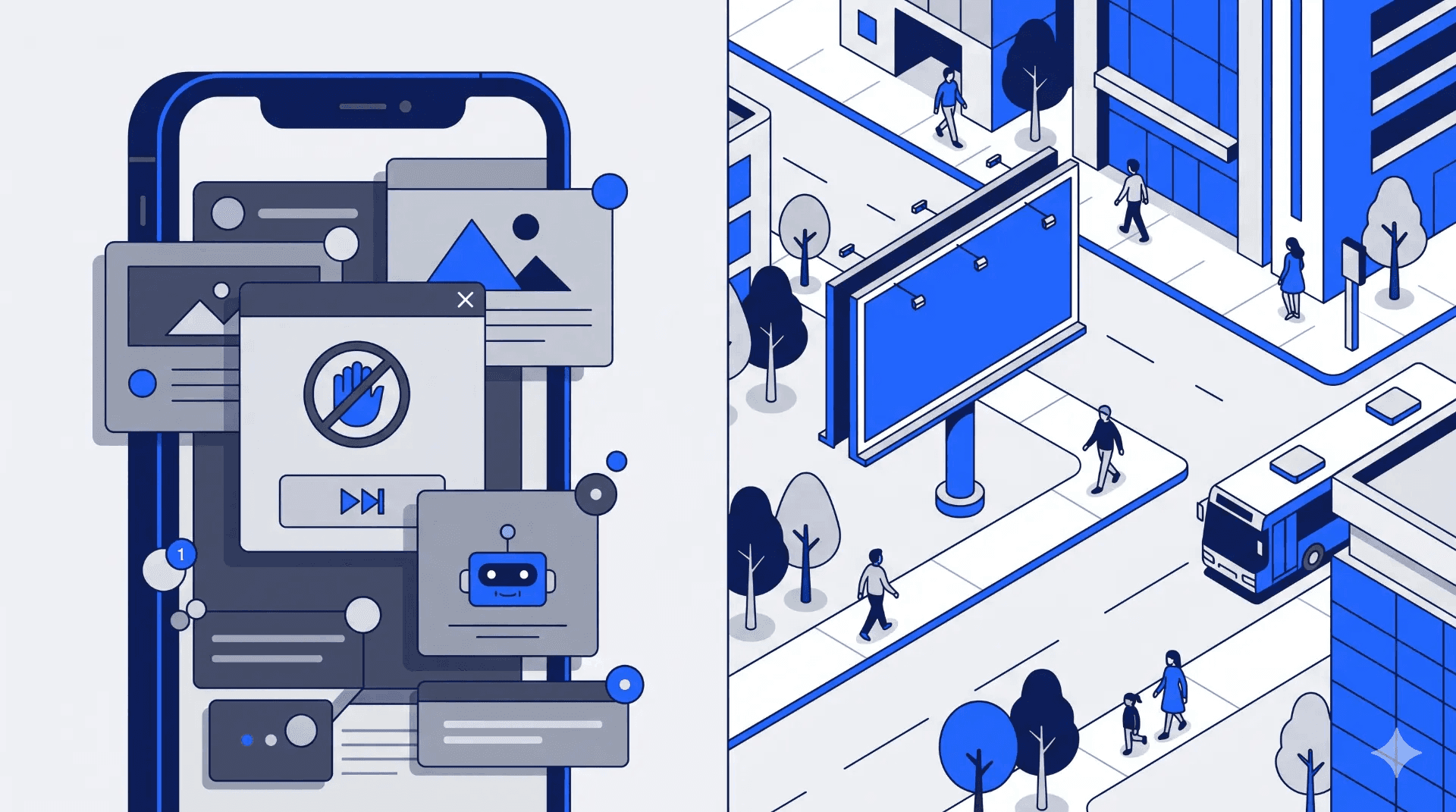
The problem no one in performance wants to admit
Every digital channel is selling the same thing: the impression. Every metric on the dashboard celebrates the same thing: the impression served. But there is a quiet, expensive gap between an impression served and an impression seen.
In digital, that gap only grows. A bot opens the page. An ad blocker kills the banner. Skip jumps the video. A tab disappears. A notification steals the focus. The creative loads, the pixel fires, the report turns green, and no one saw a thing.
This is where your OOH media has an argument few sellers know how to make: real attention. It is not nostalgia, it is not "traditional media holding on", it is a structural advantage digital cannot replicate. And, sold the right way, it justifies the rate, the planning slot and the contract renewal.
In digital, delivery is negotiated. In OOH, it is the city.
Delivery fights for attention every millisecond.
Bots, ad blockers, skip buttons, competing tabs, endless scroll, notifications. The impression happens, but attention rarely reaches the brand intact.
Delivery is the urban space itself.
No skip button, no blocker, no competing feed. The campaign becomes part of the city's routine and appears to real people, in real contexts.
This is not a sales pitch. It is an honest read of what each medium actually delivers. And for anyone selling OOH, this is the point that needs to land before the site map and before the rate card.
Digital attention is contested. OOH attention is context.
There is an important difference between the two models:
In digital, attention is an auction. Every time the user opens a screen, dozens of brands compete for that second. Whoever shouts loudest, pays most or games the algorithm best wins a tiny sliver of focus, often shared with three other tabs, a notification and the very app the ad appears in.
In OOH, attention is the journey. The message appears along the person's path: on the way to work, waiting for the bus, stopped at a light, walking through the mall. It does not compete with ten stimuli inside the same click. It competes with the landscape, and that is a fight your media almost always wins, because it is part of the landscape.
That argument alone is worth more than any reach spreadsheet. But it only works if the person selling can turn it into a conversation the advertiser recognizes.
What defending attention means, in practice, for OOH sellers
The point is not to present OOH as an "alternative" to digital, it is to present it as the fix for what digital cannot deliver on its own. Moving up from "space supplier" to "strategic partner" means changing what goes into the proposal. Four angles that, together, change the tone of the conversation:
Presence, not just reach
Show weekly frequency, repetition within the daily routine and journey coverage, metrics digital cannot replicate with the same consistency.
Physical context
The site is on a specific street, a specific neighborhood, a specific flow. That map matters to the client, and proves your media knows the territory the brand wants to be in.
Brand recall
OOH builds long-term memory. It is what sustains top-of-mind awareness when the customer goes to Google searching for exactly that product.
Immunity to noise
No bots, no ad blockers, no skip. Every impression served is, in fact, real exposure to a real person. That is a KPI digital can almost never guarantee.
Underrating OOH is costly in the advertiser's strategy
When the media plan looks only at the click, it optimizes for what is easy to measure, and ignores what is decisive for growth. Presence, coverage and brand building do not show up cleanly on a performance dashboard, but they show up in the result: a remembered brand sells more cheaply on digital, closes deals faster in sales and loses fewer customers to a new competitor.
This is the argument that was missing from the conversation. OOH does not replace digital. It corrects what digital, on its own, cannot deliver: constant presence, exposure with less noise and visual impact at human scale.
How to move past "just send me the rate card" and into strategy
There is an invisible line between the space seller and the media partner. The one on the first side answers "how much is site X?". The one who crosses to the second answers "what is the best mix for the campaign you want to run over the next 90 days?".
To cross that line, three things need to be ready before the meeting with the advertiser:
- Organized inventory, available in real time. Knowing what is free, in which windows, with what occupancy history. That becomes an argument for scarcity and exclusivity.
- Context data for each site. Type of flow, dominant audience profile, peak hours, how it connects with nearby sites. It is not a decorative map, it is a justification for the price.
- History of similar campaigns. What ran there before, with which brand, in which period. Showing this shifts the perception: you stop being a salesperson and become the one who knows the asset better than anyone.
- A clean, fast proposal. The advertiser decides quickly when the material arrives ready. Whoever takes two days to send a PDF loses to whoever sends it in two hours, with the story already told.
Without this, the conversation falls back to the rate card, and the rate card becomes an auction, and an auction is always a price war. With it, the conversation shifts from how much? to how do we run this properly?. It is a small difference in the question and an enormous one in the close.
Want to sell OOH better? Show attention, not just a rate card.
With Hivestr, your inventory, proposals, contracts and operation stay organized in one place, ready to defend value with clarity instead of chasing information right before the meeting. The system delivers the context that changes the conversation with the advertiser.
Explore the platform · 7-day free trial →Your media company's whole operation
Inventory, proposals with online approval, CRM, campaigns, proof of posting and finance in one account. 7 days free to try.
Subscribe to the Hivestr newsletter
Get tips, OOH/DOOH industry news, and Hivestr content straight to your inbox.