
Spreadsheet vs. ERP for OOH media owners: 9 signs your operation should have migrated already
The spreadsheet worked until now. But if you lose points to double-booking, build proposals in 40 minutes, collect via WhatsApp, and don't know which rep sold what — the problem isn't the team. It's the tool.
· Hivestr · 110 views
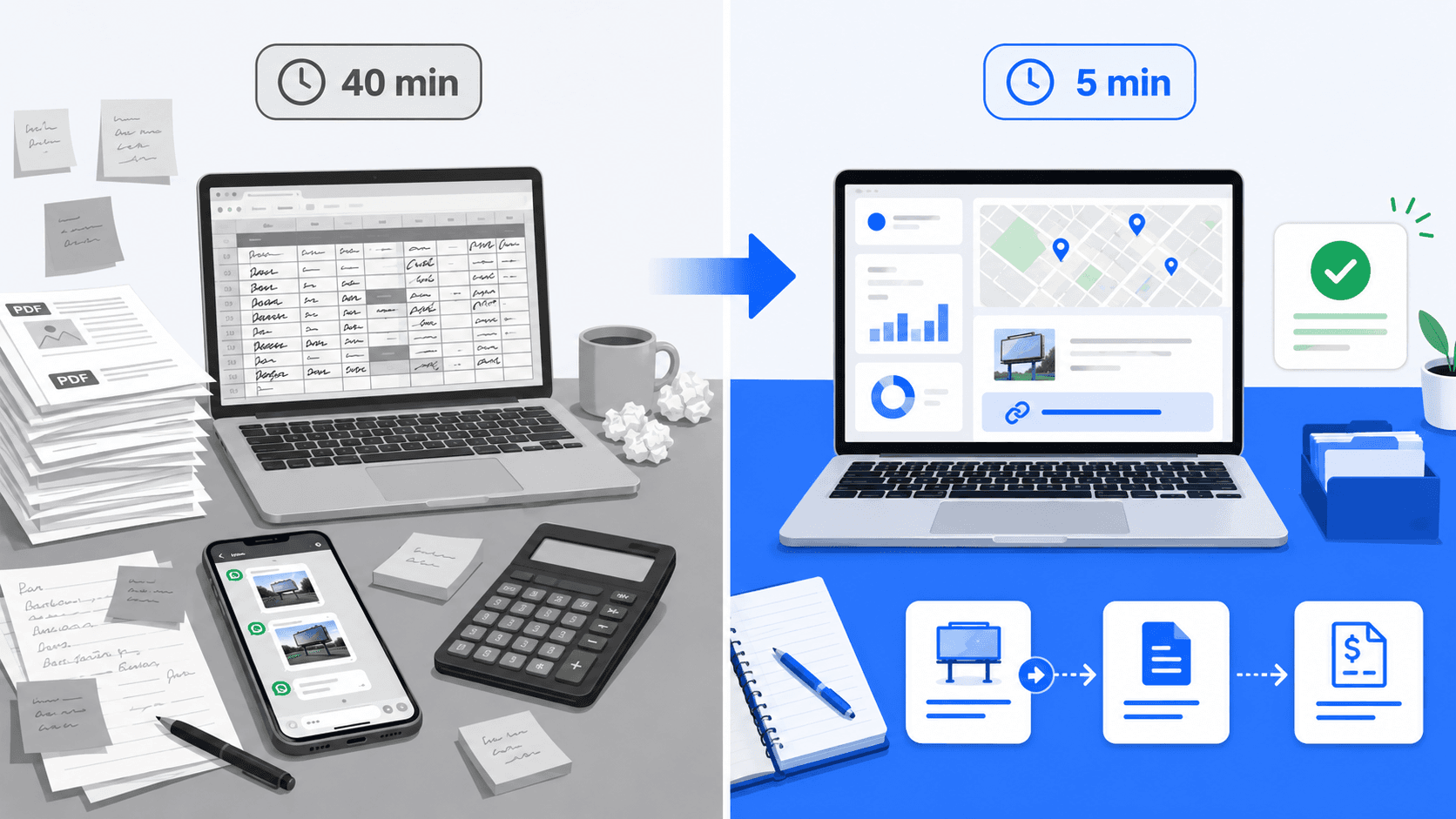
Nobody wakes up and decides to migrate from spreadsheets. What happens is different: the sales rep sells a point that was already sold. Proof is late because nobody can find the photos. The invoice is wrong because the spreadsheet price doesn't match the contract. The rep claims commission on a canceled sale. And then, in the middle of a chaotic month, someone asks: "why are we still doing all this in a spreadsheet?"
If that question has crossed your mind, this article is for you. We'll show the 9 signs the spreadsheet should have been replaced, how much it really costs in rework and lost opportunities, and what changes when a media owner migrates to an ERP built for OOH.
The spreadsheet is "free." But the sales rep's time building proposals in PowerPoint (40 min each), finance manually checking amounts, proof delayed because photos are in someone's WhatsApp, and sales lost to double-booking — all of that has a cost. In media companies with 30+ points, the hidden cost of spreadsheets reaches ~$1,700/month in rework. An OOH ERP starts at $20.
- The 9 signs the spreadsheet should have been replaced
- How much the spreadsheet really costs per month
- What changes with an ERP built for OOH
- Table: spreadsheet vs. ERP — 12 daily tasks
- How to migrate without stopping operations
The 9 signs the spreadsheet should have been replaced
You've sold the same point twice
Rep A didn't know Rep B already sold it. The spreadsheet doesn't lock availability in real time. Result: apology, rework, or losing the client.
Building a proposal takes over 15 minutes
Open spreadsheet → check availability → copy to PowerPoint → verify price → insert photos → format → save PDF → send. If it takes more than 15 minutes, the process is too manual.
You don't know if the client opened the proposal
Sent the PDF and waited. Called after 3 days. Client said they "didn't receive it." They did — and ignored it. But you don't know because PDFs don't track.
Proof lives in someone's WhatsApp
The installer sent photos to the WhatsApp group. Nobody organized them. The client asked for proof. The rep asked the installer to resend. The installer already deleted them.
Finance and sales use different spreadsheets
Sales has one spreadsheet. Finance has another. The numbers don't match. Nobody knows which version is correct. The invoice goes out wrong.
You don't know each rep's exact commission
Commissions are calculated at month-end, manually, checking sale by sale. There's always a dispute. There's always an error.
A site lease expired and nobody noticed
The lease for the highway billboard expired last month. Nobody flagged it. Now the landowner wants to renegotiate at 30% more. Without automatic alerts, expiration is a surprise.
Agencies ask for availability and you're slow to respond
The agency emailed asking for available points in August. The rep took 24 hours because they had to check the spreadsheet line by line. The agency already closed with another media owner.
You have no media kit on your site and no map with your points
The agency can't see your inventory outside business hours. If they're building a plan at 10 PM, you don't exist in that plan.
What changes with an ERP built for OOH
Real-time availability
The rep sees which points are free, builds the proposal, and the point locks automatically on approval. Zero double-booking.
Proposal in 5 minutes
Select points, the system pulls price and audience data, generates the interactive link. No PowerPoint.
Open tracking
Know if the client opened, how many times, from where. Follow-up based on data, not guesswork.
Automatic proof
Photo book born from the approved proposal. Photos attached to the point. Planned vs. delivered — automatic.
Integrated finance
Invoicing, billing, and commissions born from the proposal. One flow. No parallel spreadsheet.
Expiration alerts
Lease contracts with 30/15/1 day alerts. No expiration catches you off guard.
Table: spreadsheet vs. ERP — 12 daily tasks
| Task | Spreadsheet | ERP (Hivestr) |
|---|---|---|
| Check availability | Open file, filter, check line by line | Real-time, visual, period filter |
| Build proposal | 40 min (spreadsheet + PPT + photos) | 5 min (interactive link with data) |
| Send proposal | PDF by email | Shareable link (opens anywhere) |
| Know if client opened | Don't know | Real-time tracking |
| Approve proposal | Email / call / WhatsApp | "Approve" button in the link |
| Reserve point | Manual (double-booking risk) | Automatic on approval |
| Proof | Photos in WhatsApp + manual PDF | Auto book linked to proposal |
| Issue invoice | Separate system, verify amounts | Integrated, proposal amounts |
| Collect payment | Generate slip manually | Auto billing |
| Rep commission | Manual month-end calculation | Automatic per sale |
| Lease expiration alert | Nobody monitors | 30/15/1 day before |
| Media kit for agencies | Doesn't exist | On site, 24/7, with analytics |
The spreadsheet costs more than any ERP.
Real-time inventory, interactive proposals in 5 minutes, automatic proof, integrated finance with invoicing, media kit on your site, and expiration alerts. Everything the spreadsheet doesn't do. From R$97/month. Free trial for 7 days.
Replace the spreadsheet · 7 days free →Your media company's whole operation
Inventory, proposals with online approval, CRM, campaigns, proof of posting and finance in one account. 7 days free to try.
Subscribe to the Hivestr newsletter
Get tips, OOH/DOOH industry news, and Hivestr content straight to your inbox.