
No, every billboard is not going to become an LED panel.
DOOH is growing faster than the industry, but the numbers show a market where static and digital are both expanding. When LED pays for itself, and when it turns a profitable asset into a cash flow problem.
· Hivestr · 38 views
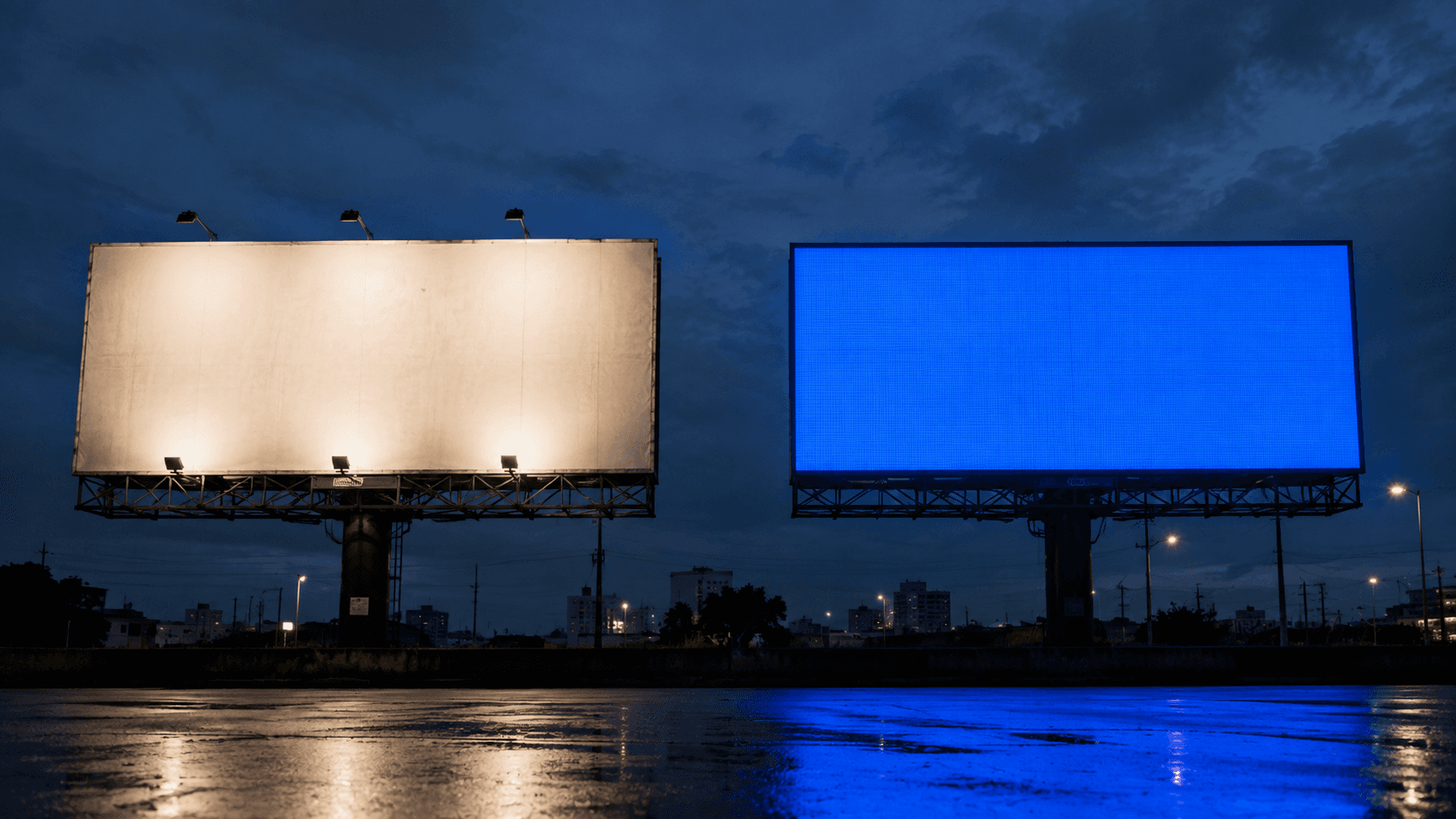
There is a prediction that circulates at every out-of-home conference, delivered with the confidence of someone stating the obvious: within a few years, every billboard will be digital. Static is the past, LED is the future, and anyone who does not convert gets left behind.
It is an easy prediction, which is exactly why it is worth examining. Easy predictions tend to confuse two different things: the direction of a trend and its endpoint. DOOH really is growing faster than the rest of the market. That does not mean it will occupy all of it.
This article argues the unpopular position: the static asset is not going away, and in many markets it will remain the economically correct decision for a long time.
Going digital is a decision about a site, not a decision about a company. The mistake is not choosing LED or static. The mistake is applying the same answer to every site in your inventory.
What the numbers actually say
Start with the most recent and most reliable data available on the US market.
In 2025, out-of-home advertising revenue reached a record 9.46 billion dollars, growing 3.6% year over year and extending the industry's run to 19 consecutive quarters of growth. The fourth quarter accelerated, rising 4.8% against the same period a year earlier.
So far, nothing that contradicts the easy prediction. The interesting part is the composition.
DOOH grew 10.5% for the year and accounts for 36.3% of total revenue. Read that sentence from the other end: nearly two thirds of out-of-home revenue in the most digitized market in the world still does not come from digital. And the OAAA reports that traditional formats also posted gains across billboards, transit, street furniture and place-based media, with transit the fastest growing segment for the second consecutive year.
This is not a market where digital is replacing static. It is a market where both are growing, at different rates, serving different needs.
A higher percentage growth rate on a smaller base does not indicate replacement. A segment representing just over a third of revenue growing 10% a year takes many years to become the majority, and that assumes the other part stands still, which the data does not show.
The math that does not work on most sites
Anyone running out-of-home knows this in practice, but the argument is rarely made explicitly. Converting a static site to LED does not change one variable. It changes the entire business model of that site.
| Dimension | Static site | LED site |
|---|---|---|
| Upfront investment | Structure and permit | Structure, panel, player, electrical install |
| Recurring cost | Print and vinyl changeover | Power, connectivity, software licensing, maintenance |
| Downtime risk | Very low | A failed module, power supply, player or link kills revenue |
| Useful life | Decades with simple upkeep | Brightness degradation and scheduled replacement |
| Exposure sold | Exclusive, all the time | A slice of the loop, shared with other advertisers |
| Technical dependency | Field crew | Field crew plus IT capability |
The critical line is the second to last, and it is the most underrated point in the whole debate. A static billboard delivers 100% of exposure time to a single advertiser. An LED panel running a ten spot loop delivers one tenth. To compensate, the media owner needs the sum of those ten advertisers to pay meaningfully more than the single advertiser paid, every month, forever.
On a very high traffic arterial with constant demand and near full occupancy, that math clears comfortably. In a mid-sized market with seasonal demand and 60% occupancy, LED turns a predictable, cheap to operate asset into an expensive one that has to be sold ten times over to earn the same money.
The static advantage nobody mentions
There is a commercial argument for static that has almost disappeared from industry conversation, and it is a strong one.
Exclusivity. When a brand buys a static billboard at a landmark location, it shares that surface with nobody. No competitor appears on the same face eight seconds later. For the entire flight, that address visually belongs to them.
That has real value for brand building, and it is precisely the kind of thing a digital media buyer cannot purchase in any other channel. Continuous impact, no competition within the same unit of space, no rotation.
Exclusive, continuous presence
One advertiser, one surface, the whole flight. Ideal for brand building, corporate campaigns, launches and market domination.
Flexibility and rotation
Creative swaps, short flights, dayparting, dynamic messaging and programmatic selling. Ideal for promotions, retail and seasonality.
Notice that both cards are green. This is not a good one and a bad one. These are two products with different value propositions, and the market needs both. Treating static as an inferior version of LED is a reading error that costs money, because it leads media owners to underprice exactly the attribute digital cannot offer.
Where regulation decides for you
There is one more dimension that usually falls outside the technical debate and is often the single most decisive variable: local sign regulation.
Zoning codes, sign ordinances, brightness limits, minimum dwell time for changeable copy, restrictions near highways and scenic corridors, all of these vary not just by state and city but by district within the same city. In many jurisdictions a face that changes images is treated as an entirely different category from a fixed surface, with a longer permitting process, operating hour restrictions or a straight prohibition.
Brazil offers an instructive extreme: São Paulo's Lei Cidade Limpa reorganized what may exist in the urban landscape from 2007 onward, and smaller versions of the same logic appear in dozens of cities. The pattern is universal even where the specifics are not.
Checking the sign ordinance for that specific address should be the first step of any conversion project, not the last. More LED projects die in a permitting office than in a spreadsheet.
So when does LED make sense
Nothing here is an argument against going digital. It is an argument against going digital indiscriminately. There is a clearly identifiable profile of site where LED is obviously the right call.
- A waiting list. You regularly turn clients away from that address because it is always booked.
- High, stable occupancy. Above 85% across the year, not only in peak season.
- Demand for short flights. Clients asking for a week or a weekend, which static serves poorly.
- Defined traffic peaks. Concentration windows that justify selling by daypart.
- Infrastructure already there. Stable power and connectivity on site, without expensive structural work.
- Favorable regulation. Zoning and sign code that permit changeable copy at that address.
If a site checks five or six of those, LED will likely pay for itself. If it checks two, you are about to turn a profitable asset into a cash flow problem with 5,000 nits of brightness.
The two symmetrical mistakes
The digitization conversation in out-of-home usually happens between two extremes, and both lose money.
Converting everything out of fear
Digitizing sites without the demand to carry the recurring cost, driven by a feeling of falling behind. Result: high capex, low occupancy and a more expensive asset earning the same money.
Converting nothing out of pride
Ignoring that real demand exists for short flights, dayparting and programmatic buying, and handing that entire budget to the competitor with a screen on the same arterial.
The media owner who wins is neither the most digital nor the most traditional. It is the one who knows, site by site, what format that specific address can carry, and can sell both in the same plan.
A hybrid inventory is the strongest position
There is a concrete commercial advantage to holding both formats, and it shows up when building a plan for an agency.
An advertiser splitting budget between brand building and promotional activation needs both things. The media owner with only static loses the promotional half. The one with only LED loses the continuous presence half. The hybrid operator builds the entire plan, controls the whole budget and shares the client with nobody.
Classify your sites
Occupancy, turned-away demand, seasonality and local sign code. Site by site, no averages.
Convert the ones asking for it
Start with those checking the most boxes on the list. One or two sites, not the whole network.
Sell them together
A package pairing continuous presence on static with activation on digital, in the same plan and the same proposal.
The answer to the easy prediction
No, every billboard is not going to become an LED panel. Digitization will keep advancing, will keep growing faster than the industry average, and will keep concentrating where demand density justifies the recurring cost.
At the addresses where it does not justify that cost, and they are the majority of addresses in any country, the static asset will keep doing what it has always done: deliver exclusive presence with low operating cost, near zero technical risk and a margin the panel only reaches when it is booked almost all the time.
The right question was never "when do I digitize my network". It is which of my sites deserve to be digitized, and what am I failing to charge for the ones that do not.
Static and digital in one system.
Geolocated records for every format, occupancy tracking per site, proposals combining static and DOOH in a single plan, media kit, embeddable map, campaign control and proof of play. Built for OOH, DOOH, TV and radio media owners. Free 7 day trial, no credit card required.
Explore Hivestr · 7 days free →Your media company's whole operation
Inventory, proposals with online approval, CRM, campaigns, proof of posting and finance in one account. 7 days free to try.
Subscribe to the Hivestr newsletter
Get tips, OOH/DOOH industry news, and Hivestr content straight to your inbox.