
Is the PDF proposal dying in the OOH market?
The PDF, email, approval and insertion order flow is giving way to interfaces where the agency filters inventory, sees pricing and books directly. But the document does not disappear the way the forecasts claim.
· Hivestr · 41 views
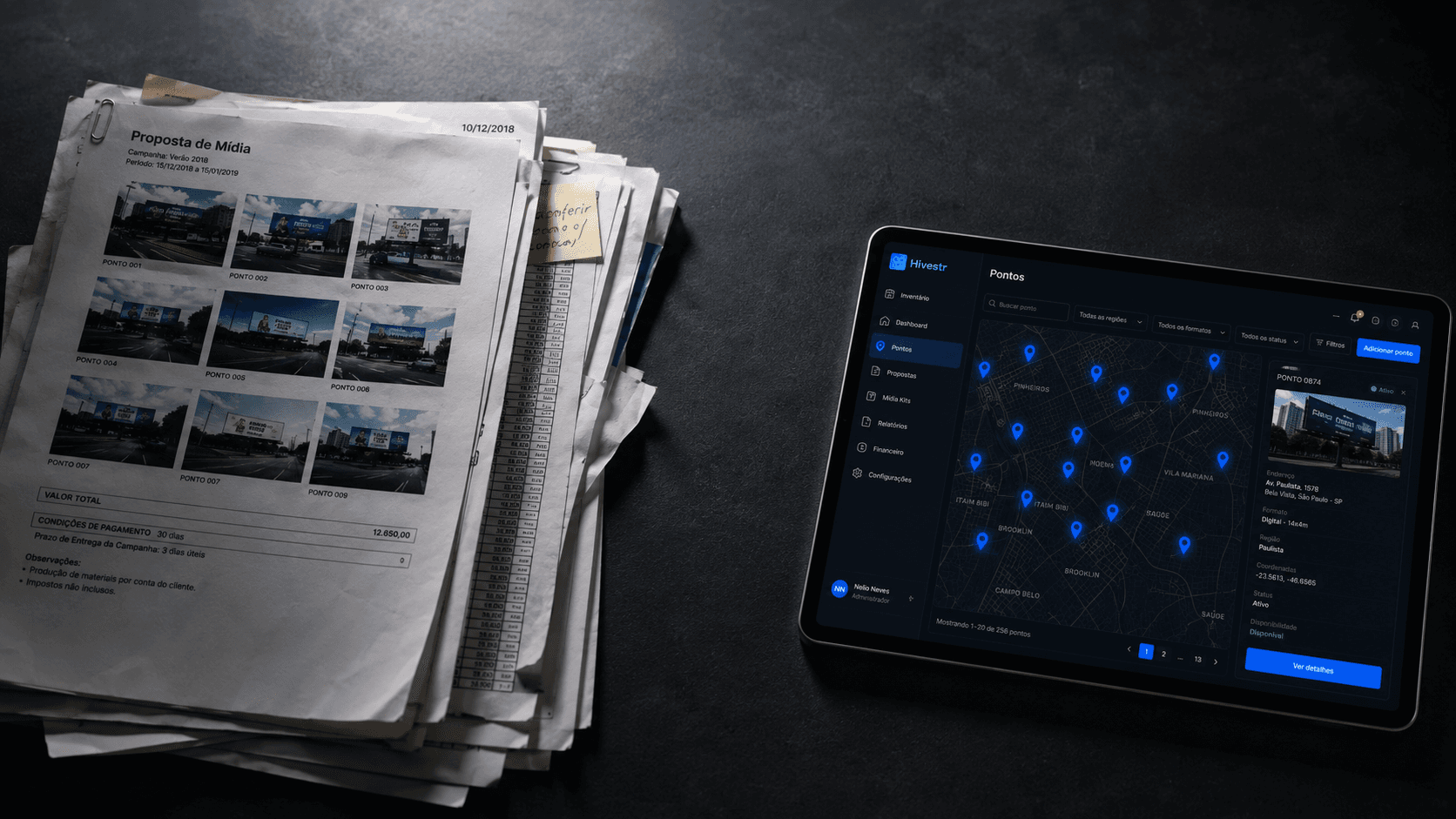
Every out-of-home media owner knows the ritual by heart. The agency calls or messages asking about availability. The salesperson opens the spreadsheet, checks, assembles a document, exports it to PDF and sends it by email. The agency disappears for three days. It comes back asking to swap two sites and change the flight dates. New PDF. Then comes approval, and only then the insertion order.
This flow is so universal that nobody questions it. But it has one strange property: the PDF is the only part of the process that creates value for nobody. Not for the person building it, not for the person receiving it.
The question in the title is deliberately provocative. Let us answer it honestly, including the reasons the PDF will survive longer than technology enthusiasm usually admits.
What is dying is not the proposal. It is the static document as a way of answering a question that was always dynamic: what is available, at what price, and can I hold it right now.
The ritual everyone accepts as normal
It is worth breaking the current flow apart and looking at each stage coldly.
The request
The agency describes what it wants in free text, by phone or message, without ever seeing the inventory.
Manual assembly
The salesperson checks availability, picks sites, calculates pricing and formats a document.
PDF and silence
The file goes out and the process enters a black box. Nobody knows whether it was ever opened.
Rework
Swap a site, a market or the dates. Back to stage two. Sometimes three times over.
Look at what happens between stage one and stage two. The agency has to describe what it wants because it cannot see what exists. All the manual assembly that follows exists only to compensate for that initial blindness.
And look at stage three. The moment the PDF is generated, it starts aging. The site that was open on Thursday may have been sold on Friday. The document keeps claiming it is available. That gap is the source of most double bookings and most awkward conversations with clients.
A proposal that takes 40 minutes to build and gets redone twice consumes nearly two hours of your salesperson's time. Multiply by the number of proposals per month and you have an entire salary being spent on document formatting rather than on selling.
What the agency actually wants is not your PDF
That usually sounds offensive to anyone who put care into the layout, but it is easy to verify. Ask any agency media buyer what they do when an OOH proposal arrives. They do not read it. They hunt for three pieces of information.
- Is it available? For the flight they need, not for any flight.
- What does it cost? Price per site and total plan value, comparable to what they received from others.
- Where exactly is it? Map location and a real photo of the site in its urban context, so they can tell whether it fits the brief.
All three of those live inside your system. The PDF is just a snapshot of them, frozen in a file that has no idea when it became outdated. It is like printing an exchange rate and mailing it.
The rest of the document, the professional cover, the company introduction, the coverage data, all of that matters. But it matters as context, not as the main product. Today the context is what consumes most of the production time, and the information that actually decides the buy is the part that is most fragile.
What replaces the document: an interface, not a file
The scenario the market is moving toward is far less exotic than it sounds, because it is already the standard experience for the same buyer in every other channel they run.
The agency opens an interface. Filters by city, by format, by flight dates and, increasingly, by audience profile. Sees on a map what is genuinely open in that window. Sees pricing. Builds the plan by dragging sites into a cart. Requests or holds the media right there. The media owner receives a request that already arrives structured, with dates, sites and values defined.
The agency describes, you assemble
The buyer cannot see the inventory. They describe what they imagine, wait, receive a PDF that may already be stale and ask for changes. Every iteration costs your team hours.
The agency assembles, you approve
The buyer sees real availability, filters, tests combinations alone and sends a request that is already viable. Your team joins the conversation to negotiate and close, not to format.
Notice the inversion in who does the work. In the file model, the media owner spends their own time exploring alternatives on the agency's behalf. In the interface model, the agency explores on its own, at no cost to you, and only shows up once it has a plan that stands.
Why the PDF does not die tomorrow
This is where most articles on the subject lose credibility, promising a revolution that does not match the reality of anyone selling OOH in a mid-sized market. There are four solid reasons the document will stick around for a long while.
Negotiated pricing is not rate card pricing
A large share of the market runs on volume discounts, relationship pricing and urgency to fill unsold inventory. Exposing rates in a public interface is a delicate commercial decision, not a technical one. The middle ground the market is landing on is pricing visible behind a login, with discount policy applied by client tier.
The insertion order and legal still want paper
Authorization to run, contracts and invoicing still require a formal document. The difference is that this document is now generated at the end of the process, as the consequence of a plan already built, rather than at the beginning, as the vehicle for negotiation.
Relationships still close deals
Nobody buys out-of-home from a cold catalogue the way they buy display in an auction. Trust, delivery track record and the ability to solve problems remain decisive. The interface does not replace the salesperson. It removes the clerical half of the job.
Most media owners still lack organized inventory
This is the real barrier. You cannot expose in an interface an inventory that lives across three spreadsheets in different versions. Moving to the interface model is not a sales technology project. It is an inventory data project, and the technology is only the consequence.
The bottleneck was never building a nice screen for the agency to browse. It is having an inventory base reliable enough that the availability shown on that screen is true in real time. Without that, the interface just automates the error.
What actually dies is the salesperson as formatter
Put both halves of this article together and you arrive at a more precise answer than the title suggests.
The proposal does not die. The relationship does not die. The formal document does not die. What dies is the sales professional who spends half the day cross-checking spreadsheets, picking photos, adjusting a figure in the footer and exporting a file. That function disappears because it is the one part of the process a system does better, faster and without error.
Notice that the middle column is already the present for many media owners. The third column is where the market is heading, and getting there does not require a revolution. It requires the same data foundation that the second column already demands.
What to do now
Three moves ordered by dependency. There is no point jumping to the third without the first.
One source of availability
If two people on your team can give different answers about the same site on the same date, nothing beyond this works.
Proposals that become links
While the document still exists, make it interactive and trackable. You need to know if it was opened and what was looked at.
Inventory exposed to the buyer
An embeddable map and media kit on your own website, so the agency can browse without depending on your business hours.
Step two deserves a note. Swapping the PDF for a link is not cosmetic. The PDF is a black box: you send it and know nothing until the agency replies. A proposal delivered as a link shows when it was opened, how many times, and which sites drew the most attention. That changes the timing and the content of your follow-up, and it is the first concrete gain most media owners actually feel.
The honest answer to the question in the title
No, the PDF proposal is not going to die in out-of-home over the next few years. It will keep existing, mainly as a formal record and in negotiations that depend on conversation.
What is going to die is the PDF as the starting point of the negotiation. It is migrating from the front of the process to the back, from a selling instrument to a record of agreement. And that migration changes everything for media owners, because anyone still treating the document as the main product will be competing, with two hours of manual work, against someone who answers in two minutes.
The question left standing is not whether the PDF dies. It is whether your inventory is organized enough to survive without it.
Your proposal can be a link, not an attachment.
Geolocated inventory with real time availability, interactive proposals with open tracking, an embeddable media kit and map for your website, campaign control and proof of play. All in one system built for OOH, DOOH, TV and radio media owners. Free 7 day trial, no credit card required.
Explore Hivestr · 7 days free →Your media company's whole operation
Inventory, proposals with online approval, CRM, campaigns, proof of posting and finance in one account. 7 days free to try.
Subscribe to the Hivestr newsletter
Get tips, OOH/DOOH industry news, and Hivestr content straight to your inbox.