
In the future, nobody will buy your billboard. They'll buy its audience.
Out-of-home is shifting from selling space to selling audience. Here is what changes at the negotiating table, and what media owners need to organize now to avoid becoming a commodity.
· Hivestr · 36 views
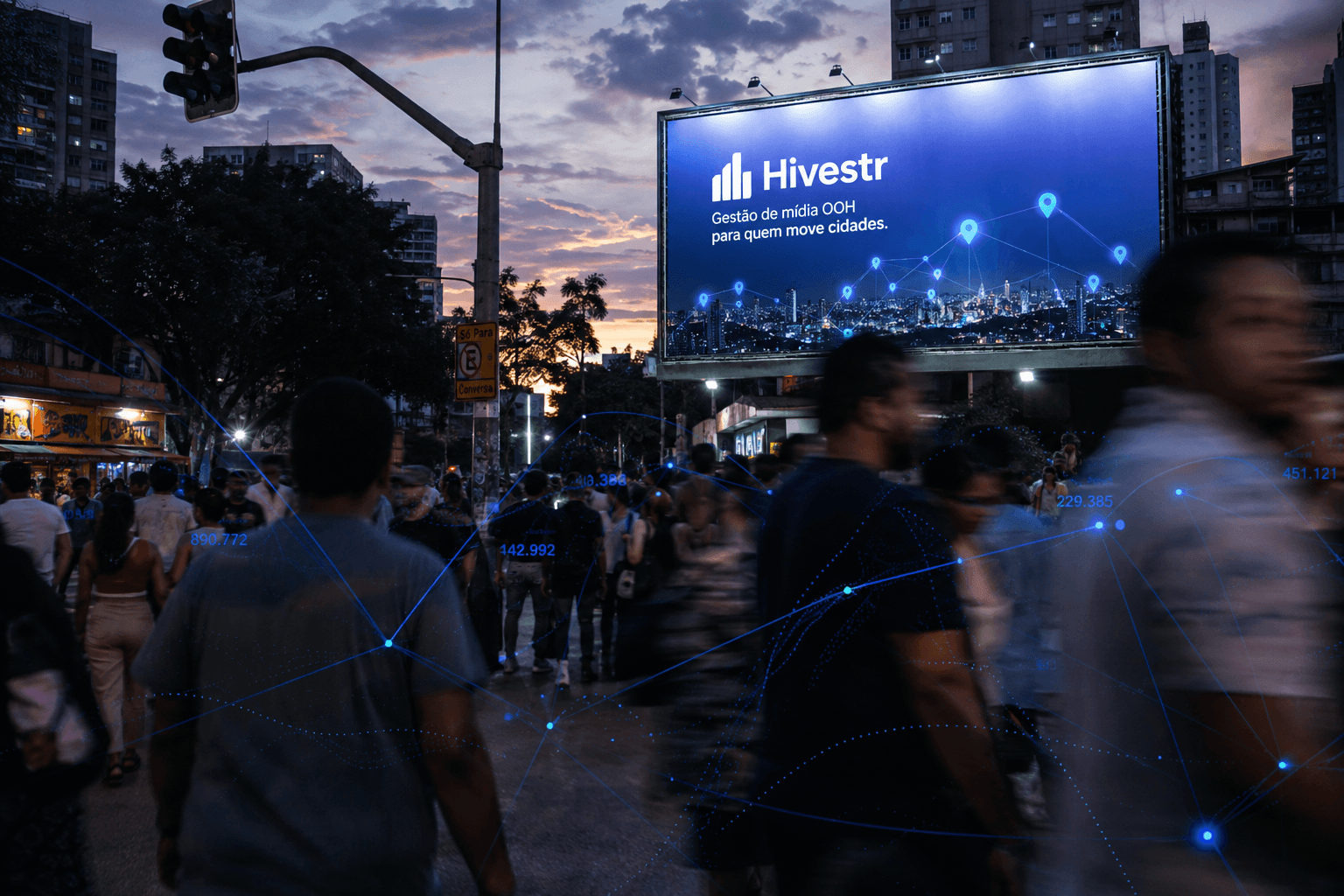
For decades, out-of-home media was sold with a single sentence, some version of "I have a billboard on that avenue." And it worked. The site was the product, the avenue was the argument, and whoever owned the best address owned the best business.
That sentence is dying. Not overnight, not everywhere at once, but it is dying. The question replacing it is far less comfortable: how many people pass here, who are they, at what time of day, and how often?
Media owners who can answer that with data will sell. Those who cannot will become a commodity and compete on price alone.
This is not a distant forecast. It is a shift in the unit of negotiation that is already happening at the media buying table, and it redefines who holds pricing power in out-of-home over the next few years.
What changed was not the medium, it was the buyer
A billboard is still a billboard, an elevator screen is still an elevator screen, an LED display is still an LED display. What changed is who sits on the other side of the table.
Today's media buyer is no longer just the art director who fell in love with a site. It is a planner who has to place OOH in a spreadsheet next to Meta, Google, YouTube, CTV and retail media, and defend that allocation internally. That planner does not work with "busy avenue". That planner works with impressions, reach, frequency, CPM and, increasingly, attribution.
While OOH spoke the language of space, the rest of the industry spent twenty years learning the language of audience. The bill has now arrived.
The IAB published a DOOH measurement guide precisely because the channel grew fast while living with inconsistent standards and fragmented practices. The document exists to align buyers and sellers around a shared framework for evaluating performance, covering everything from data collection to attribution, audience targeting and programmatic buying models. It also framed DOOH as one of the fastest growing channels in digital media, with the US market projected to reach 3 billion dollars in 2025.
When a body like the IAB has to write a manual so that buyers and sellers can speak the same language, the pressure for comparable measurement has stopped being a trend and become a market requirement.
Selling audience is not buying technology
This is where the industry's most expensive misunderstanding lives.
When audience comes up, many media owners hear "I will have to buy sensors, cameras, traffic counters, a DSP, an SSP and build a data team". That is not it. That is one path, and not always the best one.
Selling audience means, first and foremost, changing the unit of negotiation. You stop selling "the screen at mall X for 30 days" and start selling "27,000 qualified impressions per week, concentrated between 11am and 2pm, skewing to a high income audience, with an average frequency of 3.2".
Infrastructure comes later. What comes first is the discipline of knowing five things about every site in your inventory.
- How many. Pedestrian or vehicle flow, with a stated methodology.
- Who. Income profile, age range and the context of the location.
- When. Distribution by hour and by day of the week.
- How often. How many times the same person is exposed in a week.
- With what real chance of being seen. Not everyone who passes actually looks, and that changes what the site is worth.
None of those five items requires hardware. All of them require method and record keeping. Most media owners already have the raw data scattered across contracts, spreadsheets, map screenshots and the memory of their longest serving salesperson. What is missing is the structure to turn that into a commercial argument.
Why this is good news for the media owner
The pessimistic reading is: "they will force me to prove everything and then squeeze my rates". The correct reading is the opposite.
When you sell space, the only possible differentiator is the address. And addresses are finite, expensive and usually already owned by someone else. You compete against whoever has a better site than yours, and you lose. When you sell audience, variables you actually control enter the game.
| Variable | Selling space | Selling audience |
|---|---|---|
| Unit sold | Site per period | Qualified impression |
| Competitive edge | Address | Qualification and context |
| Pricing argument | Square meters and visibility | CPM and frequency |
| Packaging | Site by site | Route, cluster, market, profile |
| Comparability | Only against other OOH | Against any digital channel |
| Who wins | Whoever owns the best address | Whoever organizes inventory best |
Qualification
A screen in the lobby corridor of a high income residential building, with 40 seconds of captive dwell time, can be worth more per impression than a roadside billboard where cars pass at 40 miles per hour. That only shows up if you measure it.
Context
"People leaving for work between 7am and 9am" is a product. "Elevator screen" is an inventory line item. The first sells to banks, insurance and delivery apps. The second sells to whoever is left.
Recurrence
Frequency is the most underrated metric in OOH. A small audience exposed five times a week for a month delivers recall that mass media cannot buy for the same money. But you have to be able to say that as a number.
Packaging
With audience data, you stop selling sites and start selling routes, clusters, markets and profiles. You sell 40 average sites as a single reach product, which is impossible when every site is negotiated on its own charm.
The cost of standing still
It is worth being blunt about the alternative. A buyer who cannot measure OOH does not stop buying media. They buy something else. They move the budget to wherever the report writes itself at the end of the flight. And within OOH itself, they move the budget to the media owner who sends the report.
This is already visible. Proof of play has stopped being a differentiator and become a baseline expectation. Anyone still sending a loose photo over a messaging app as evidence is competing against someone sending a structured report with date, time, player and proof. It is not the same conversation and it is not the same rate.
Where to start, in practice
No romanticism and no two year project. Three moves that fit any operation, regardless of size.
Standardize every site record
Geolocation, media type, dimensions, operating hours, estimated flow, surrounding profile and a current photo. All in one place.
State your methodology
Flow without a source is a guess, and buyers know it. With a stated source it becomes data. The difference is not precision, it is credibility.
Always deliver the report
Even when nobody asks. The report is what builds the track record you will use in the next sale.
On step two, one detail matters. Estimated flow without methodology is a guess and the buyer can tell. Estimated flow with a stated methodology, whether that is census data for the block group, a traffic count from the highway authority, the number of units in the building or your own sample count, is data. None of these three steps requires hardware investment. All of them require a decision.
The bottleneck is almost never measurement technology. It is the fact that inventory information lives across three spreadsheets, an inbox and somebody's memory. You cannot sell an audience you cannot even list.
The asset was never the steel structure
Billboards are not going away. Elevator screens are not going away. Out-of-home is the last channel a consumer cannot block, skip or hide with a browser extension, and that is worth more over time, not less.
What is going away is the ability to sell that space without being able to explain what stands in front of it.
The out-of-home operator's asset was never really the steel structure. It was always the audience passing by. The difference is that, until now, you could sell that asset without ever having to name it. That part is over.
Your audience data cannot live in a spreadsheet.
Geolocated inventory with a complete record per site, interactive proposals, media kit, an embeddable map for your website, campaign control and proof of play. All in one system built for OOH, DOOH, TV and radio media owners. Free 7 day trial, no credit card required.
Explore Hivestr · 7 days free →Your media company's whole operation
Inventory, proposals with online approval, CRM, campaigns, proof of posting and finance in one account. 7 days free to try.
Subscribe to the Hivestr newsletter
Get tips, OOH/DOOH industry news, and Hivestr content straight to your inbox.