
How to Start an Outdoor Media Company from Scratch: Complete Guide to OOH and DOOH
From your first billboard lease to a professional operation — everything you need to know to launch, structure, and scale an outdoor media company in the United States, covering both traditional OOH and digital DOOH formats.
· Hivestr · 152 views
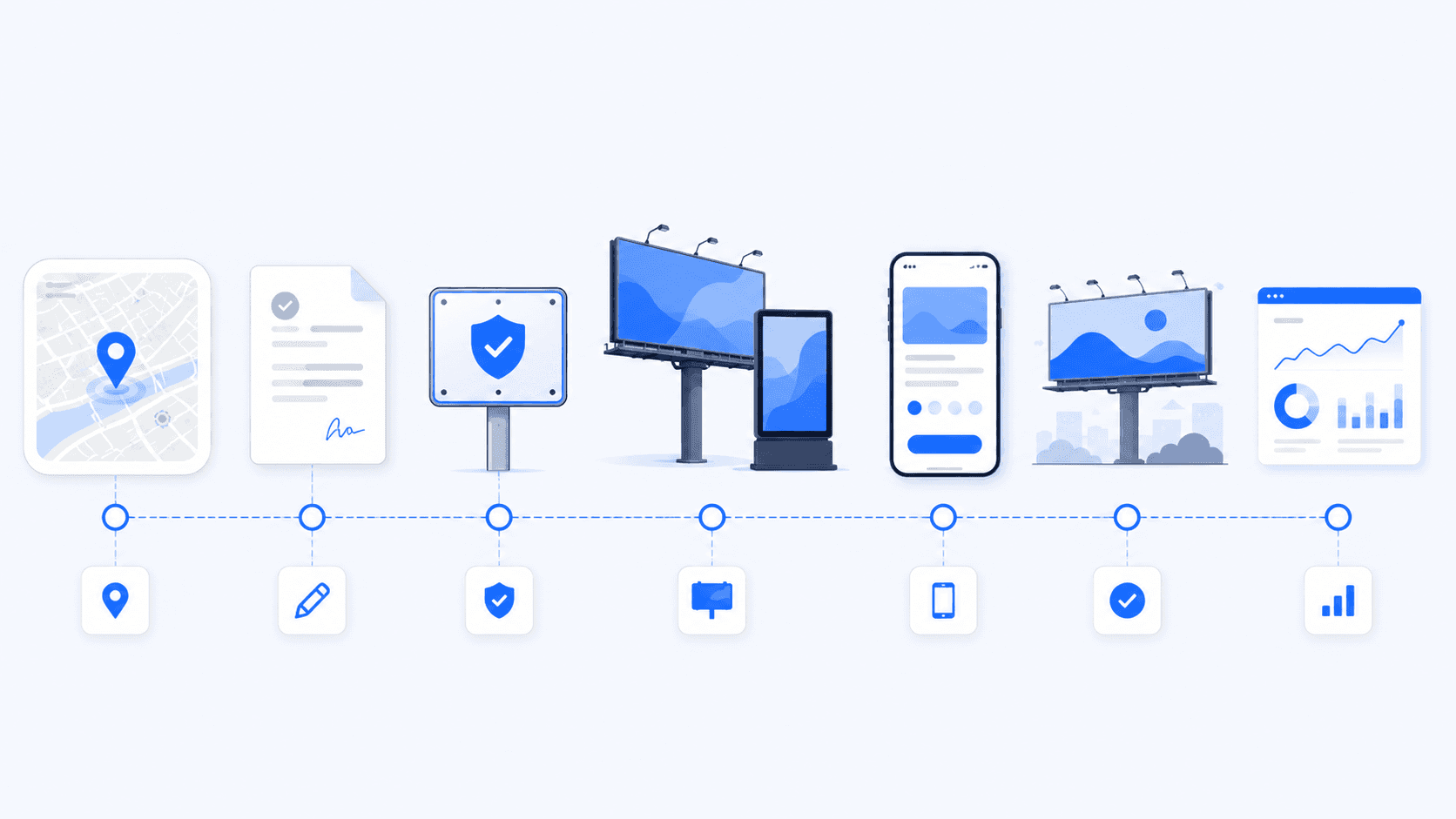
How to Start an Outdoor Media Company from Scratch: complete guide to OOH and DOOH
Starting an outdoor media company is one of the most accessible entry points into the advertising industry — and one of the most misunderstood. The perceived barrier is high; the actual barrier is not. You don't need a massive operation to begin. You need access to the right locations, a structured commercial process, and the operational discipline to turn ad space into recurring revenue.
This guide covers everything: what an OOH and DOOH media company actually is, how to find and negotiate your first sites, how to navigate U.S. permitting, how to price your inventory, how to sell, what changes when you add digital screens, and what technology to use to run the operation without drowning in spreadsheets.
It's a long guide because starting an outdoor media company involves many decisions. Use the sections below to navigate to what you need right now.
The U.S. OOH market: why now is a strong time to enter
The outdoor advertising industry in the United States is in the middle of a sustained growth run that most traditional media channels can't match.
OOH advertising revenue reached a record $9.46 billion in 2025, marking 3.6% year-over-year growth and extending the industry's growth to 19 consecutive quarters. The top OOH advertisers in 2024 included Apple, McDonald's, Amazon, Coca-Cola, Verizon, and Disney — but more than 25% of the top 100 OOH spenders were technology or direct-to-consumer brands, reflecting a major shift in who's buying outdoor media.
Local OOH ad sales represent 65% of total revenue — which means the market is driven overwhelmingly by regional and local operators serving local advertisers. That's the space an independent outdoor media company competes in, and it's where most of the opportunity lives.
What an outdoor media company actually does
An outdoor media company secures the rights to display advertising at high-traffic locations, then sells that space to advertisers who want to reach the audience passing through. The operator sits between the landowner (who has the location) and the advertiser (who has the budget) — and captures margin on that relationship.
The core business model is straightforward: you pay a ground lease to the property owner, charge the advertiser for the campaign period, and keep the difference after operating costs. The complexity is in choosing the right locations, pricing well, keeping occupancy high, and scaling without losing operational control.
OOH vs DOOH: which to start with
| Criteria | OOH (traditional static) | DOOH (digital screens) |
|---|---|---|
| Media type | Printed vinyl or paper on structure | LED or LCD digital display |
| Changing advertisers | Requires new print + installation | Remote content swap in seconds |
| Multiple advertisers per face | One at a time | Loop rotation — 4, 6, 8 at once |
| Initial investment | Lower (structure + printing) | Higher (screen + infrastructure) |
| Operating cost | Print + install per campaign | Power + screen maintenance |
| Content flexibility | Low — fixed for the campaign run | High — dayparting, triggers, dynamic |
| Average deal size | Lower, more predictable | Higher, more variable |
| Operational complexity | Medium | High (hardware + software + connectivity) |
For most first-time operators, starting with traditional OOH — static billboards or smaller format structures — is the lower-risk path. Lower upfront capital, simpler operations, more predictable cash flow. DOOH makes sense when the operation has traction, or when a specific location has characteristics that justify the screen investment.
The business model: three ways outdoor media companies make money
1. Direct site ownership and operation
You lease land from a property owner, install the structure, and sell advertising directly to local businesses and agencies. Your margin is the spread between what you charge advertisers and what you pay in ground rent plus operating costs. This is the most common model for independent operators.
2. Municipal concessions and transit contracts
In some markets, municipalities award contracts to operate street furniture, bus shelters, transit stations, or public kiosks. The operator pays a concession fee or revenue share to the city in exchange for exclusive rights to the advertising inventory. Higher upfront commitment, but long-term contracts and protected inventory.
3. Representation and resale
You represent the inventory of other operators, selling their space on commission — typically 15–25%. No capital investment in structures required. Lower margin per transaction, but an excellent way to learn the market and build agency relationships before committing to owned sites.
Finding and evaluating your first sites
The location is your primary asset. Everything else — pricing, sales, margins — flows from the quality of where your structure sits. Choosing weak locations at the start creates a legacy of hard-to-sell inventory that drains cash.
What makes a strong OOH location
How to negotiate the ground lease
The contract with the property owner is the foundation of your site. Key terms to negotiate:
- Minimum 5-year initial term with renewal options — ensures you can amortize your structure investment
- Exclusive right to install and operate advertising on the property — prevents the landlord from leasing to a competitor
- Annual rent escalation tied to CPI — protects your margin as costs rise
- Express right to install, maintain, and modify the structure
- Adequate notice period for termination — 180 days minimum is reasonable for established structures
- Right of first refusal if the property is sold — protects your investment if ownership changes
- Clearly defined maintenance responsibilities between parties
Permits, regulations, and federal law
Outdoor advertising in the United States operates under a three-layer regulatory framework: federal law, state DOT requirements, and local municipal zoning. All three must be satisfied before a structure can legally operate.
The Highway Beautification Act
The cornerstone of federal regulation is the Highway Beautification Act (HBA) of 1965, which controls billboard placement along Interstate and Federal-Aid Primary highways. Under the HBA, billboards within 660 feet of Interstate and federal highway rights-of-way must comply with size, spacing, and lighting standards — and must be located in commercial or industrial zones. Scenic and residential areas along federal highways are generally off-limits.
State DOT permits
Businesses must secure permits from both the state Department of Transportation (DOT) and the local municipality's planning or zoning board. State DOT permits are required for any sign visible from a federal or state highway, even if the structure itself is on private land. State-level permit processing times average 30–90 days, with expedited options available in certain jurisdictions for additional fees.
Local zoning and municipal permits
Local zoning determines where billboards are permitted, what sizes are allowed, minimum spacing between structures, lighting restrictions, and (increasingly) digital display rules. Requirements vary dramatically by city and county. Some municipalities have moratoriums on new billboard permits entirely.
What you'll typically need to submit
- Site plan showing exact billboard placement and property boundaries
- Engineering drawings stamped by a licensed professional engineer (PE)
- Structural calculations and foundation design
- Proof of land control (signed lease or deed)
- State DOT permit application (for sites near state/federal highways)
- Local zoning permit application
- For digital displays: light study report showing compliance with brightness standards
- Annual operating license renewal ($200–$2,000 per structure depending on jurisdiction)
Business structure and financials
Legal entity
Most independent outdoor media operators form an LLC (Limited Liability Company) for the operational and tax flexibility it provides. As the operation grows and investors or partners come in, a C-Corp or S-Corp structure may make more sense. Consult a CPA familiar with media and real estate — the ground lease and depreciation treatment of structures have specific tax implications.
Cost structure of an outdoor media company
| Cost Category | Description | Type |
|---|---|---|
| Ground rent | Monthly payments to property owners for site rights | Fixed |
| Print and installation | Vinyl production and posting for each static campaign | Variable per campaign |
| Structure maintenance | Painting, repairs, lighting replacement, cleaning | Fixed + periodic |
| Electricity | Illuminated static panels and DOOH screens | Fixed (~$300–500/mo per digital screen) |
| Connectivity (DOOH) | Data link for remote content management | Fixed per screen |
| Sales team | Salesperson salaries, commissions (typically 10–15% of billings) | Fixed + variable |
| Management software | ERP, CRM, proposals, billing | Fixed |
| Insurance | General liability, structure coverage, umbrella policy | Fixed |
| Accounting and legal | CPA, permits, contract review | Fixed |
Target margin structure
A healthy outdoor media operation targets 50–70% gross margin after ground rent and direct campaign costs (print + install). Net margin after overhead (team, software, insurance, admin) typically runs 25–40% for a well-run independent operator. Below 50% gross margin, any increase in ground rent or print costs compresses the business dangerously.
Pricing: how to set rates for your OOH inventory
Pricing outdoor media is part market research, part math, and part conviction. Pricing too low trains the market to expect discounts. Pricing too high without data to back it up creates objections that stall deals.
The factors that determine a location's rate
- Traffic volume (AADT) — higher daily traffic = higher CPM = higher rate
- Format and size — larger formats in more prominent positions command premium rates
- Illumination — illuminated panels run 24 hours and justify a significant rate premium
- Location type — highway vs. arterial vs. retail corridor each have different market rates
- Market size — a billboard in Manhattan prices differently than one in Tulsa, even at the same traffic count
- Competitor pricing — what other operators charge for comparable inventory in the same DMA
- Your ground rent — the rate must cover fixed costs and generate margin
Standard rate card structure
The OOH market standard is to sell in 4-week periods. Many operators also offer 8-week and 12-week packages with progressive discounts. Build your rate card with three tiers: gross rate (full price), agency rate (15% commission off gross — standard trade practice), and volume/extended rate (for multi-location or extended campaign buys).
Sales structure: how to sell outdoor advertising
Selling outdoor media is different from most B2B sales. The advertiser isn't buying a product — they're buying visibility, reach, and impact. Your job is to translate an empty face on a structure into a concrete business argument for a specific buyer.
Who your customers are
The 5-step sales process
Map businesses already advertising in your market — on competitor billboards, in local publications, on social media. Anyone already spending on advertising has a budget. Focus especially on businesses near your locations: they have obvious motivation to reach the audience already passing your structures.
Before building a proposal, understand what the advertiser is trying to accomplish: brand awareness, drive-to-store, new location launch, or seasonal promotion? The objective determines which of your locations makes the most sense — and how to frame the value argument.
Build a proposal with the selected locations, real photos, an interactive map, campaign period, and pricing. Send via an interactive link — not a PDF attachment. You need to know if the prospect opened it, when, and how many times. That data defines your follow-up timing.
The best follow-up happens within an hour of the prospect opening the proposal. "I saw you had a chance to look at the proposal — any questions on the locations?" is far more effective than calling three days later with no idea if they even saw it.
Approved proposal becomes a signed contract, invoice, and production order. The location comes off availability. Print is ordered. On the start date, the campaign goes up and proof of posting is sent to the client.
DOOH: what changes when you go digital
Digital out-of-home adds operational complexity — but opens revenue possibilities that static formats can't match. A single screen can serve multiple advertisers simultaneously, change creative remotely in seconds, and target by time of day, day of week, or real-world conditions.
Digital billboards remain dominant in sheer revenue with a 38% share in 2025. According to a 2024 survey, 74% of mobile device users took action on their phones after seeing a DOOH ad — a cross-channel effect that static formats can't replicate.
Infrastructure requirements for DOOH
- Commercial-grade LED or LCD display rated for outdoor use (IP65 minimum for external installations)
- Embedded or external media player to manage content scheduling
- Reliable data connection (cellular 4G/5G, fiber, or fixed wireless) for remote management
- Surge protection and power conditioning equipment
- Content management system (CMS) — platforms like Broadsign, VNNOX, NovaCloud, or similar
- Remote monitoring system to detect outages and screen issues in real time
- Defined preventive maintenance schedule (screen cleaning, connection checks, firmware updates)
Two ways to sell DOOH inventory
Exclusive period: one advertiser occupies the full screen for a defined period, identical to the static OOH model. Simpler to manage, easier to explain to first-time buyers.
Loop rotation: multiple advertisers share the screen in rotation — each gets a defined slot (e.g., 10 seconds in a 60-second loop = 1/6 share). This multiplies revenue per screen: 6 advertisers on one face at once. But it requires tighter operational control — proof of play logs, per-advertiser reporting, and conflict-of-interest management (no competing brands in the same loop).
Proof of posting: the verification that closes the loop
Proof of posting (or "proof of play" in DOOH) is the documentation that a campaign is actually running as contracted. For static OOH, it's a photo of the installed creative at the location with date and time. For DOOH, it's a play log generated by the media player recording every impression served.
This step sounds simple. Many operators skip it or do it informally — sending a WhatsApp photo or attaching a snapshot to an email. That's a missed opportunity. Proof of posting sent through a professional platform, tied to the original proposal and campaign, builds trust, reduces chargebacks, and opens the door to renewal conversations without friction.
In DOOH, automated proof of play — timestamped logs showing each creative play — is increasingly expected by agency buyers. Operators who can provide it programmatically command higher rates and win repeat business from media planners who need the data for client reporting.
Technology: the management system your operation needs
Spreadsheets work when you have 5 locations and one salesperson. They break when you have 20 locations, three salespeople, overlapping campaigns, and invoices that need to go out on time. The transition from spreadsheet to system isn't a luxury — it's a prerequisite for scale.
What an OOH management ERP needs to do
- Inventory registration with photos, geolocation, and technical specs per location
- Availability control by site and period — no overbooking, no conflicts
- Interactive proposal generation with map, photos, and approval link
- Proposal analytics — who opened, when, on which device
- Live media kit — available inventory published on your website in real time
- Campaign management with start and end dates, booking, and timeline
- Proof of posting — photo upload tied to campaign and client delivery
- Billing and invoice generation — integrated payment processing
- Financial dashboard — revenue by location, active campaigns, P&L
Hivestr is a vertical ERP built specifically for OOH, DOOH, TV, and radio media operators. Not a generic CRM with custom fields — a platform that was designed understanding what availability by period means, what a proof of posting workflow looks like, and what the complete campaign cycle requires. Core plan from R$ 147/month, no per-user pricing.
How to scale: from local operator to regional player
Growth in an outdoor media company comes from two directions: more locations in your existing market, or expansion into new markets. Each has different dynamics.
More locations in your current market
The simplest path — you know the regulations, you have existing advertiser relationships, and your operational infrastructure is already in place. The challenge is that the best locations in any established market are already claimed. Finding quality inventory means either waiting for contracts to expire or approaching smaller operators about acquisitions.
Expanding into new markets
Entering a new DMA requires researching local zoning from scratch, mapping the competitive landscape, building landlord relationships, and establishing a local sales presence. The biggest mistake operators make is trying to sell remotely without local representation — in outdoor media, relationships drive deals, and relationships require physical presence.
Partnerships and rep agreements
A capital-efficient way to scale is establishing representation agreements with operators in other markets — you sell their inventory on commission, they sell yours. This expands the portfolio you can offer to agencies without requiring capital investment in new structures. Many mid-size independents have grown this way before building or acquiring assets in new markets.
Common mistakes first-time operators make
- Building before permitting — risk of forced removal and total structure loss
- Underpricing to win first accounts — low-margin accounts don't scale and train the market to expect discounts
- No written ground lease — total dependence on the landlord's goodwill
- Taking on slow-pay advertisers when cash is thin — receivables problems are fatal early on
- Operating without a management system — spreadsheets break exactly when you can't afford the chaos
- Skipping proof of posting — generates advertiser disputes and chargeback exposure
- Ignoring DOOH maintenance — a dark screen destroys client relationships faster than it destroys revenue
- Expanding too fast before the core operation runs without founder dependency
Conclusion: what separates outdoor media companies that grow from those that stay small
Starting an outdoor media company is accessible. Scaling it is the real test. The operators who grow share three things: well-chosen locations, a structured commercial process, and an operation managed well enough to generate margin consistently.
Billboards remain the dominant OOH format, with 74.5% of revenues coming from large-format ads in Q1 2025 — and 70% of the top 100 OOH advertisers increased spending compared to 2024. The market is moving in the right direction. The question isn't whether there's demand for outdoor media. The question is whether your operation is structured to capture it consistently — with the right locations, the right sales process, and the right tools to manage it without the founder being in the middle of everything.
What turns a location into a business is how you manage it.
Build your outdoor media operation with the right structure from day one
Hivestr is the ERP for OOH and DOOH operators. Inventory, proposals, campaigns, proof of posting, billing, and invoicing in one platform. Try free for 7 days.
Create free account →Your media company's whole operation
Inventory, proposals with online approval, CRM, campaigns, proof of posting and finance in one account. 7 days free to try.
Subscribe to the Hivestr newsletter
Get tips, OOH/DOOH industry news, and Hivestr content straight to your inbox.