
October 8, 2026
How to raise your OOH rate card for 2027
Inflation is only the floor. Use your costs, occupancy and real discounts to set the right increase, and communicate it without losing clients
1 views
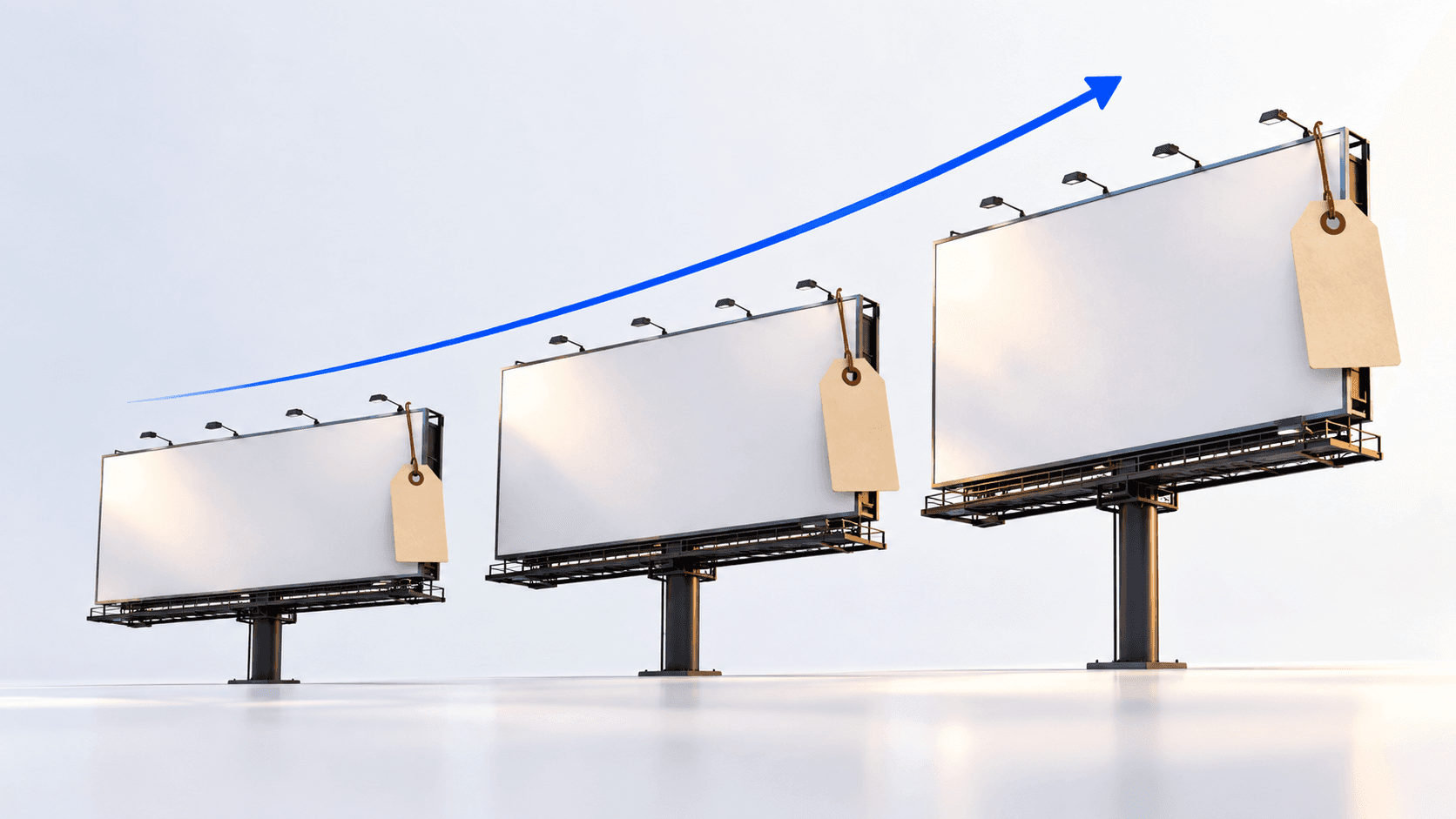
Every year end, the same question pops up for anyone running an OOH media business: how much should the rate card go up? Raise it too much and agencies push back while advertisers disappear. Don't raise it and site rent, power, vinyl and labor go up anyway, quietly squeezing your margin.
The truth is that many media owners set their increase by gut feeling. They copy the inflation index, or worse, leave the rate card untouched for two or three years for fear of losing clients. In this article we show how to build your 2027 increase on your own operating numbers, how to communicate it to agencies and advertisers, and what to do with contracts already running.
Why October is the right time
Agencies and advertisers lock in next year's plans and budgets between October and December. If your new rate card arrives in January, it lands after the budget was already approved at your old price. Then you are left with two bad options: hold the old price all year, or renegotiate with clients who already closed their numbers.
A rate card that arrives after the budget is approved isn't an increase. It's a renegotiation, and you almost always lose those.
Set your 2027 rate card by early November and send it to agencies and key advertisers by mid-month. That way it goes into their planning, and the new prices take effect with the first posting period of January.
Inflation is the floor, not the increase
The most common path is to apply the inflation index and call it a day. In Brazil, 12-month IPCA inflation stood at around 4.2% through August 2026. That number works as a minimum reference: if your increase is below it, you are getting cheaper in real terms.
But official inflation measures a household consumption basket, not the cost of running an OOH business. What actually weighs on your cash flow is different: rent for sites and buildings, power for LED screens, printing, posting, maintenance, municipal permits and payroll. And those costs rarely move exactly in line with consumer inflation.
The 3 numbers that define your increase
Instead of looking only at the index, look inside your operation. Three numbers tell the whole story:
| 2026 occupancy | What it means | Suggested increase |
|---|---|---|
| Above 80% | Demand exceeds supply. You are leaving money on the table. | Comfortably above inflation. The most sought-after faces can go up more. |
| 60% to 80% | Healthy operation, price close to equilibrium. | Inflation plus the real change in your costs. |
| 40% to 60% | Inventory sits empty for much of the year. | Match inflation and work on occupancy before going further. |
| Below 40% | The problem is probably not price, but sales or site quality. | Selective increase. Review weak sites before touching the whole rate card. |
These ranges are a reference to guide the decision, not a fixed rule. Every market, format and client profile has its own dynamics.
Don't raise the whole rate card evenly
Applying the same percentage to every face is simple, but it wastes opportunity. A well-built rate card treats each site according to its performance.
An alternative to a flat increase is a base price plus a premium in high-demand periods. The client advertising in February pays less, and the one competing for Black Friday pays what that period is really worth.
What about running contracts?
This is where most of the headaches live. A client with an annual contract or an insertion order already signed for next year can't simply be handed the new rate card.
Leaving the rate card frozen for years to avoid losing clients is the most expensive path. When the math finally catches up, the increase needed is so large that this is when the client actually leaves. Annual, predictable, moderate increases are far easier to accept.
How to communicate without losing clients
How the increase is delivered matters as much as the number. A few practices that reduce friction:
Clients rarely leave over a fair increase. They leave when they feel they paid more and got the same thing.
Your 2027 rate card checklist
Getting the increase right is less about finding the perfect percentage and more about having the right numbers at hand. If you know what each site costs, how much it sells and what it really sells for, you can defend your price calmly in front of any agency.
Set your prices with data, not guesswork.
Hivestr is the ERP and CRM built for OOH, DOOH, TV and radio media owners. Occupancy by site and by posting period, history of actual prices, contracts with renewal dates and your rate card, all in one place.
Start your 7-day free trial →12-month IPCA inflation through August 2026 according to the series published by IBGE (Brazilian Institute of Geography and Statistics). The occupancy and increase ranges are editorial references to guide decisions and do not replace analysis of each media owner's own numbers. For contracts, consult your legal advisor on escalation clauses.
Subscribe to the Hivestr newsletter
Get tips, OOH/DOOH industry news, and Hivestr content straight to your inbox.