
How to create an OOH proposal that converts (and why PDFs with point photos don't work anymore)
The proposal is the moment the sale happens or dies. See the 7 mistakes that kill OOH proposals, what a converting proposal needs, and how media owners who changed formats doubled their approval rate.
· Hivestr · 90 views
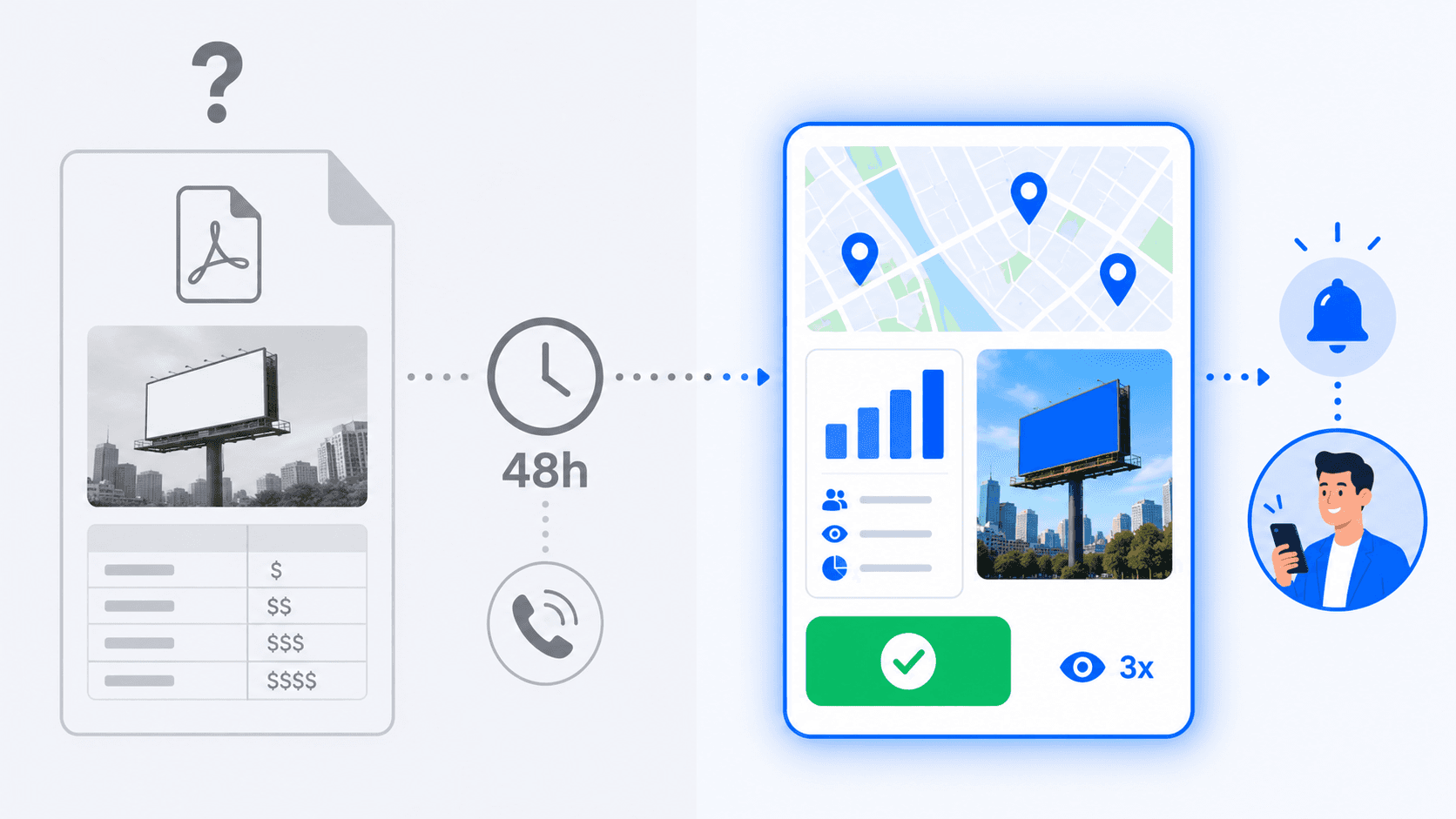
The commercial proposal is the most important moment in selling outdoor media. Not the location, not the price, not the relationship — the proposal. Because it's what the advertiser sees, what the agency forwards, and where the "yes" or "no" happens. If your proposal is a PDF with a point photo, price table, and "estimated 50K vehicles/day," you're competing with one hand tied — because someone is sending interactive proposals with real data.
Your proposal competes with digital's — which has dashboards, real-time metrics, and calculated ROI. If yours arrives as a PDF without data, the advertiser doesn't reject OOH. They reject the proposal.
- The 7 mistakes that kill OOH proposals
- Anatomy of a proposal that converts
- PDF vs. interactive proposal: side by side
- What changes when proposals have audience data
- The full cycle: from proposal to cash in one flow
The 7 mistakes that kill OOH proposals
Too slow to send
If it takes more than 2 hours from request to delivery, the agency has already consulted competitors. The first proposal the advertiser sees has disproportionate advantage.
Static format (PDF/PowerPoint)
Attachment the advertiser needs to download and open. On mobile, they won't. When forwarded, it gets lost in email. A shareable link solves this.
Point photo without context
A billboard photo alone says nothing. Where is it? What's the traffic? Who sees it? The point needs to be on a map with context.
"Traffic estimate" instead of real data
"50K vehicles/day" has no source, no date, and doesn't convince anyone used to digital metrics. Camera data with real impressions, dwell time, and profile changes the game.
Loose pricing without calculation
Price table per point without total investment, CPM, cost per real impression. The advertiser wants "how much per thousand people who see my ad" — not "how much does this billboard cost per month."
Approval by email
"Please confirm by email if approved." Emails get lost, delayed, ambiguous. Online approval inside the proposal link — with a button — eliminates 80% of post-send friction.
No tracking
You send the proposal and don't know if the client opened it. Don't know how many times. Don't know from where. Real-time tracking shows when to follow up — and when to stop.
Anatomy of a proposal that converts
- Shareable link (not a file). The client receives a link. Opens on mobile, desktop, tablet. Forwards to another decision-maker without losing formatting.
- Interactive map with points. Each point on the map with photo, address, and data. The client explores on their own.
- Real audience data per point. Camera-measured impressions, dwell time, demographic profile. If integrated with Datavisiooh, this data is live in the proposal.
- Total investment calculated. Not a price table per point — the full campaign total with breakdown by format, period, and CPM.
- Multi-format mix in one proposal. Static OOH + DOOH + TV + radio in a single document.
- Online approval with one button. The client clicks "approve." The point is automatically reserved. No email, no call.
- Real-time tracking. Who opened, from where, how many times, how long they stayed. The rep knows exactly when to follow up.
- Connected to the full flow. Approval triggers reservation → proof → finance → invoicing → commission. The proposal isn't the end — it's the start of an integrated flow.
PDF vs. interactive proposal: side by side
| Element | PDF / PowerPoint | Interactive proposal (Hivestr) |
|---|---|---|
| Format | File attachment (gets lost) | Shareable link (opens anywhere) |
| Point location | Isolated photo, no context | Interactive map with all points |
| Audience data | "Traffic estimate" | Real impressions, dwell time, profile (Datavisiooh) |
| Investment | Price table per point | Total calculated with CPM and breakdown |
| Format mix | One format per proposal | OOH + DOOH + TV + radio in one |
| Approval | "Please confirm by email" | "Approve" button with auto-reservation |
| Tracking | None (don't know if opened) | Who opened, from where, how many times |
| Time to build | 30-60 minutes | 5-10 minutes (data pulled from inventory) |
| After approval | Manual reservation + separate finance | Reservation → proof → invoicing automatic |
What changes when proposals have audience data
The sales argument shifts from format to audience
Instead of "billboard for $X/month," the conversation becomes "Y thousand real impressions per day with Z seconds of exposure." The advertiser compares with digital using the same language.
Premium pricing is justified
Points with 5x above-average dwell time can charge more — and the proposal shows why. Without data, premium is guesswork. With data, it's evidence.
Point comparison becomes objective
In the same proposal, the client sees data from each point side by side. They choose based on evidence, not the rep's intuition.
Interactive link. Live data. One-click approval.
Interactive proposals with Datavisiooh audience data, map with all points, calculated investment, online approval, open tracking, and integrated flow to finance. Stop sending PDFs. Start sending proposals that convert. Free trial for 7 days.
Try Hivestr · 7 days free →Your media company's whole operation
Inventory, proposals with online approval, CRM, campaigns, proof of posting and finance in one account. 7 days free to try.
Subscribe to the Hivestr newsletter
Get tips, OOH/DOOH industry news, and Hivestr content straight to your inbox.