
Hivestr vs. RD Station CRM: one is built to sell outdoor media, the other isn't
RD Station CRM is a solid B2B sales tool — but it has no media inventory, availability control, interactive proposals with analytics, photo proof of posting, or integrated billing. See the full comparison.
· Hivestr · 129 views
Hivestr vs. RD Station CRM: one is built to sell outdoor media,
the other isn't
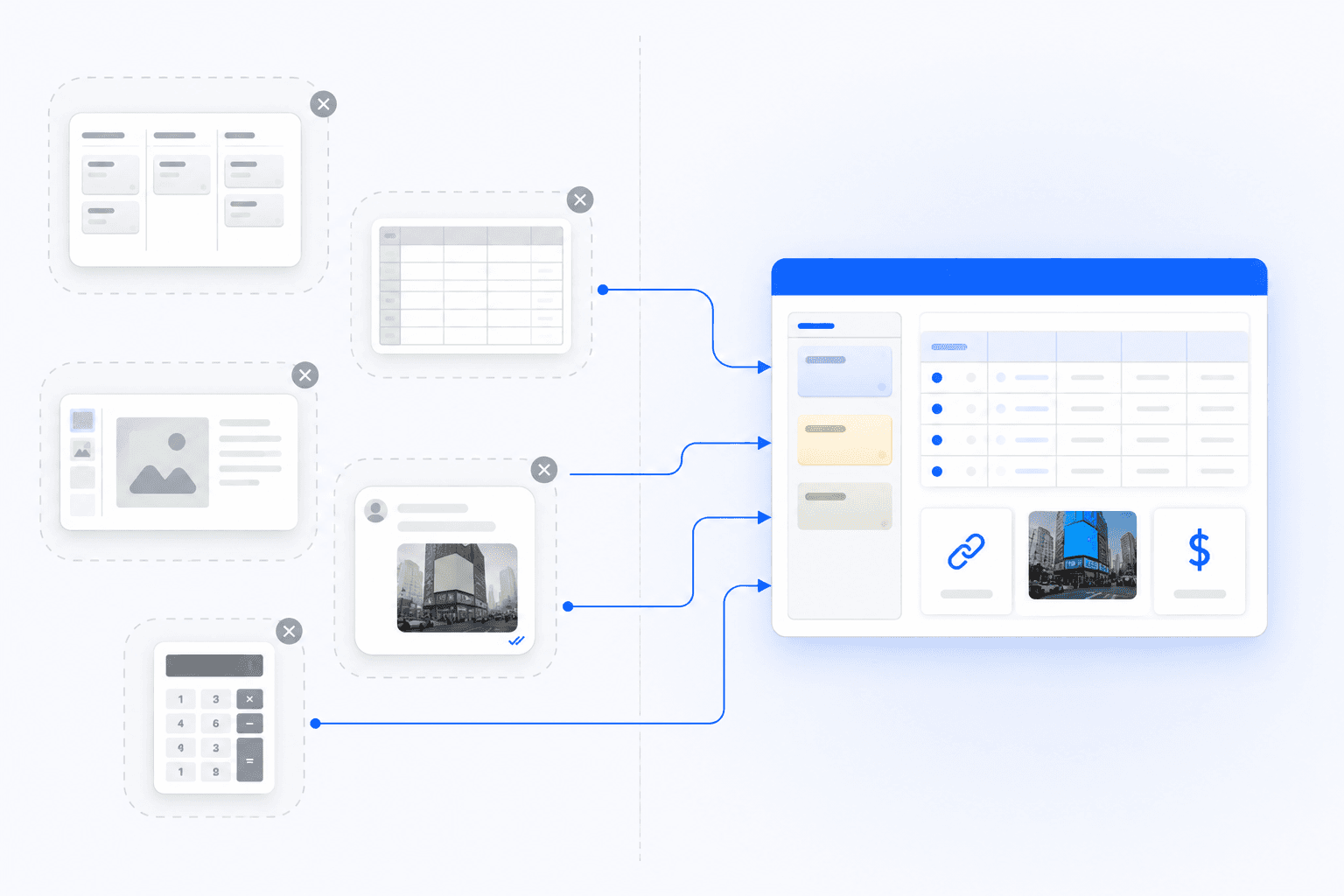
RD Station CRM is a benchmark for B2B sales in Brazil — well built, well positioned, with a robust marketing and automation ecosystem. But it was made for any company selling anything. And when "anything" needs to become a media inventory, interactive proposals with view analytics, proof-of-posting photos, and campaign management with airing dates — the generic tool stops.
Hivestr is a vertical ERP built exclusively for OOH, DOOH, TV, and radio media operators. Not an adapted CRM — a platform that was born understanding what a media point is, a face, an availability slot, an insertion order, a service invoice for airtime.
In this article, we compare both platforms honestly. Where RD Station delivers, we say so. Where it falls short, we explain why. And where Hivestr solves what no generic CRM can, we show how.
What RD Station CRM does well
It would be dishonest to say RD Station doesn't work. It does — and well — for what it sets out to do. It's a sales CRM with a visual pipeline, task automation, native integration with RD Station Marketing, virtual phone, and email-based proposal sending. It has a free plan for up to 4 users and an inbound marketing ecosystem few Brazilian competitors match.
If you run a services company, consultancy, education business, or SaaS, RD Station CRM can be an excellent choice. It solves the problem of organizing pipelines, logging interactions, and qualifying leads with lead scoring. But that's not the problem an outdoor media operator faces.
Where RD Station CRM falls short — and why it matters
This isn't a criticism of RD Station. It's a category issue. Generic CRMs were not designed for the operational reality of a media operator. Here's what's missing:
Media inventory management
A media operator needs to register each point with location, format (billboard, LED, street furniture, bus shelter), dimensions, face, market, photos, and rate card price. RD Station has no concept of a "media point" — it has "deals" and "products." You can improvise with custom fields, but you're forcing a model that wasn't built for this.
Availability control and overbooking prevention
When a media point is sold for a given period, it needs to automatically disappear from availability. RD Station has no calendar control per asset. Two salespeople can sell the same billboard for the same period and no one notices until the conflict surfaces on site.
Interactive proposals with analytics
Hivestr generates commercial proposals with an approval link, map of media points, photos, pricing — and tracks who opened it, how many times, on which device. RD Station generates a basic PDF proposal inside the deal. No interactive link, no analytics, no map.
Media map and live media kit on your website
In Hivestr, your inventory automatically becomes an embeddable map on your website and a live media kit that agencies can consult at any time. In RD Station, your inventory doesn't exist as a visual concept — there's no way to publish a dynamic map or media kit.
Proof of posting (checking)
Need to prove the campaign is live? In Hivestr, proof of posting is done inside the platform — photo, date, point, and delivery to the client. In RD Station, proof of posting doesn't exist. You'd have to do it externally, via Google Drive folders or WhatsApp.
Integrated billing and invoicing
Billing, bank slips, overdue account tracking, service invoices, P&L — all inside Hivestr. RD Station has no financial module. You'd need a separate system to charge clients and issue invoices.
Side-by-side feature comparison
| Feature | RD Station CRM | Hivestr |
|---|---|---|
| Sales pipeline / funnel | ✓ Yes | ✓ Yes |
| Task automation and follow-up | ✓ Yes | ✓ Yes |
| WhatsApp integration | ✓ WhatStation | ✓ Yes |
| Lead scoring | ✓ Via RD Marketing | ✗ No |
| Marketing automation / Inbound | ✓ Full ecosystem | ✗ No (focus on operations) |
| Media inventory management | ✗ No | ✓ Location, format, photos, rate card |
| Availability control by period | ✗ No | ✓ Calendar per media point |
| Interactive proposal with link | ✗ PDF only | ✓ Link with map, photos and approval |
| Proposal analytics (opens, device) | ✗ No | ✓ Yes |
| Embeddable media map on website | ✗ No | ✓ Yes |
| Live / dynamic media kit | ✗ No | ✓ Updates in real time |
| Campaign management with airing dates | ✗ No | ✓ With booking and timeline |
| Proof of posting (photo + delivery) | ✗ No | ✓ Photo + point + client delivery |
| Billing and bank slip integration | ✗ No | ✓ Banco Inter + Efí Bank |
| Service invoice issuance (NFS-e) | ✗ No | ✓ Yes |
| P&L / financial reporting | ✗ No | ✓ Yes |
| Operations dashboard (proposals + revenue) | Partial (sales only) | ✓ Commercial + financial + campaigns |
| TV and radio in the same inventory | ✗ No | ✓ Yes |
| Mobile app | ✓ Yes | ✓ Yes |
Source: official websites and public documentation of both platforms, consulted in July 2026. Features may vary by plan and product updates. Where no official confirmation was found, we use "Not confirmed."
The real workflow of a media operator — and where each platform fits
Hivestr ✓
RD Station ✗
Hivestr ✓ (interactive)
RD Station ✓ (PDF)
Hivestr ✓ (analytics)
RD Station ✗
Hivestr ✓
RD Station ✗
Hivestr ✓
RD Station ✗
RD Station CRM covers part of this workflow — relationship management and pipeline tracking. But a media operator's workflow has 5 stages, and the generic CRM only covers 1.5 of them. The rest becomes spreadsheets, WhatsApp, Google Drive folders, and a separate billing system.
Pricing: what each dollar buys
RD Station charges per user. With 5 users on the Basic plan, you pay around R$ 330/month — and still have no inventory, map, proof of posting, financial module, or invoicing. You'd need to add other systems on top.
At Hivestr, R$ 147/month on the Core plan already includes the entire operation: inventory, proposals, CRM, campaigns, proof of posting, billing, map, and media kit. Everything in one place. And the price is per operation, not per user.
Who each platform is the right choice for
Choose RD Station CRM if:
Your company sells services, consulting, education, or SaaS. You need a generic sales pipeline with marketing automation, lead scoring, lead nurturing, and inbound integration. Your operation has no physical media inventory and doesn't need availability control by period.
Choose Hivestr if:
You operate OOH, DOOH, TV, or radio media. You need to register media points, control availability, generate interactive proposals with maps and analytics, manage campaigns with airing dates, do proof of posting, bill with bank slips, and issue service invoices — all without leaving one platform.
Hivestr is the ERP — for companies that sell media.
The trap of the adapted generic CRM
Many media operators try using generic CRMs (RD Station, Pipedrive, HubSpot) and "adapting" them with custom fields, auxiliary spreadsheets, and Zapier integrations. It works at first. But as the operation grows, the workarounds pile up:
Inventory lives in a spreadsheet. Availability nobody keeps updated. The proposal goes out as a generic PDF with no media point photos and no map. Proof of posting happens on WhatsApp. Billing lives in a separate financial system. And the manager has no consolidated view of anything.
Hivestr eliminates that fragmentation. Just because you can adapt a generic CRM doesn't mean you should. The right question is: how many hours per week does your team spend stitching together systems that don't talk to each other?
Conclusion
RD Station CRM is a solid, well-built tool with a strong ecosystem and a generous free plan. If you run a services or SaaS company, it may be a perfect fit.
But if you operate outdoor media points, what you need isn't a CRM — it's an ERP that understands your business: inventory, availability, interactive proposals with analytics, proof of posting, billing, invoicing. Hivestr was built for exactly that.
We're not saying RD Station is bad. We're saying it solves a different problem than yours.
Try Hivestr free for 7 days
See how the complete media operator workflow works in a single platform.
Create free account →Your media company's whole operation
Inventory, proposals with online approval, CRM, campaigns, proof of posting and finance in one account. 7 days free to try.
Subscribe to the Hivestr newsletter
Get tips, OOH/DOOH industry news, and Hivestr content straight to your inbox.