
Hivestr vs. LDSK (Signkick): outdoor media ERP vs. programmatic trading bridge
One runs your entire business — CRM, proposals, proof, finance. The other connects your screens to the programmatic world. See where each fits and why Hivestr covers more.
· Hivestr · 191 views
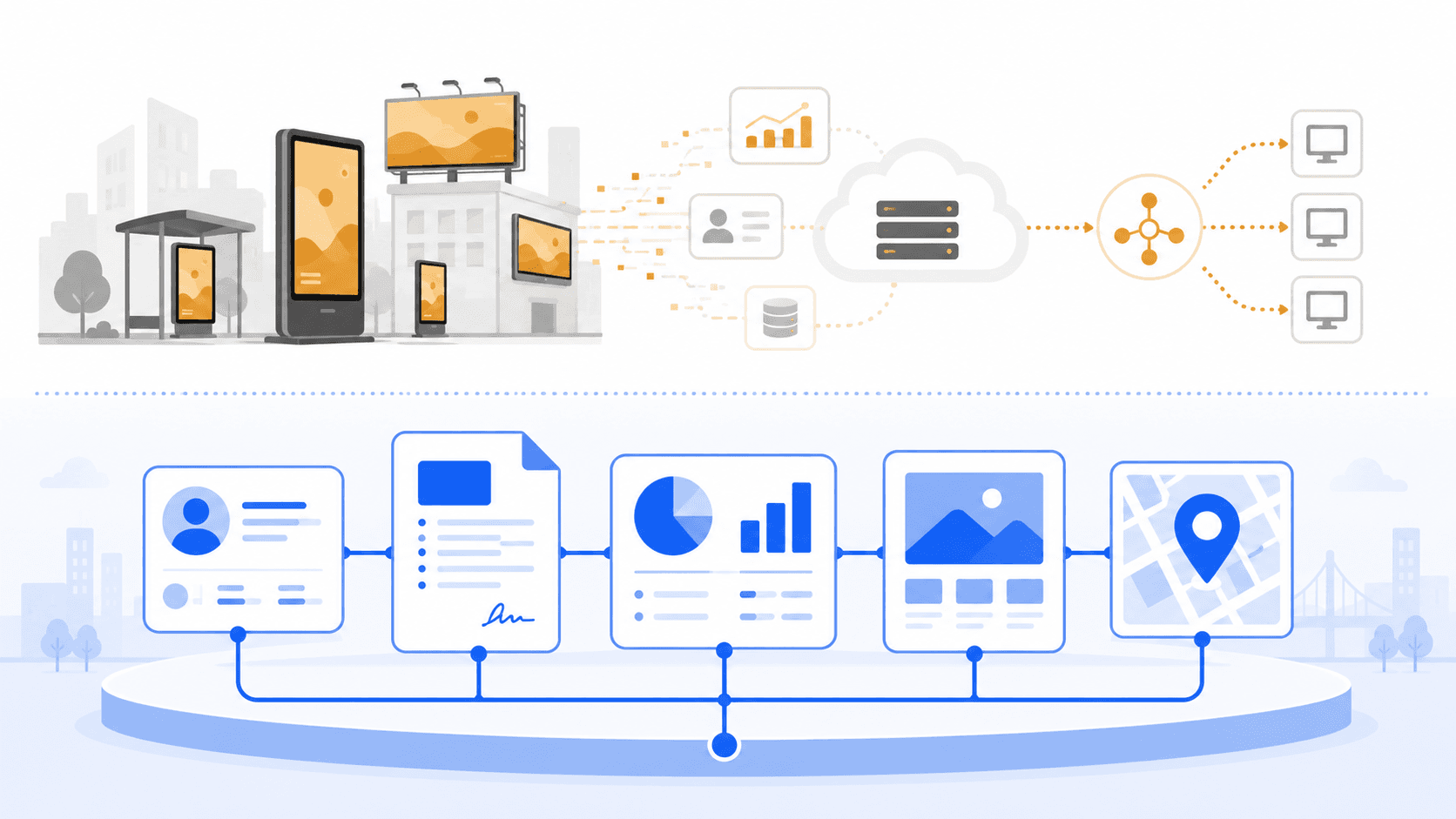
If you search for "outdoor media software" and "DOOH software," you'll find two types of tools that look like competitors but solve completely different problems. LDSK (formerly LiveDOOH/Signkick) was born in the UK to optimize scheduling and programmatic trading for digital screens — with clients the size of Clear Channel, JCDecaux, and Shell. Hivestr was built in Brazil to cover the entire operation of a media vehicle: from CRM to proposal, from proof of delivery to finance, from media kit to agency marketplace.
This article explains why they're not direct competitors — and why, even though they could coexist, Hivestr covers far more of the day-to-day of an outdoor media company than a trading bridge does.
LDSK is an intelligent scheduling and programmatic trading layer for DOOH networks. It's not an ERP: no CRM, no commercial proposals, no photographic proof, no invoicing, no financial module. Hivestr is the complete ERP for media vehicles — inventory, CRM, proposals, campaigns, proof, finance, service invoices, media kit, and marketplace. If you run digital screens at scale and want DSP connections, LDSK handles that layer. If you need to run the entire business, Hivestr is the platform.
- What LDSK actually does (and what it doesn't)
- What Hivestr covers that LDSK doesn't touch
- Where they could coexist — and where Hivestr is enough
- Side-by-side comparison table
- How to choose between the two
What LDSK actually does (and what it doesn't)
LDSK (the result of merging LiveDOOH and Signkick) is headquartered in the UK and positions itself as an intelligent scheduling and revenue maximization platform for DOOH and retail media owners. Its clients include major networks like Clear Channel, JCDecaux, Global, Shell, and Schiphol Airport.
Intelligent scheduling
Goes beyond traditional loops: supports audience-based campaigns, share of voice, play-based selling, and variable content lengths. Optimizes airtime to sell more.
Programmatic trading
Connects media owners with DSPs and automated buyers via Trading Bridge. Supports guaranteed and non-guaranteed real-time deals.
Yield management
Per-screen revenue optimization: fills idle airtime, prioritizes campaigns by value, and maximizes network revenue.
White-label e-commerce
Lets media owners sell inventory directly online, capturing long-tail advertisers who don't go through agencies.
LDSK is exceptional at what it does. But what it doesn't do is equally important when evaluating tools:
- CRM and sales pipeline. Doesn't manage contacts, deal history, or commercial funnel.
- Commercial proposals. Doesn't generate proposals with investment calculations, audience data, and shareable approval links.
- Photographic proof. Doesn't create a photo verification book or insertion report (delivered vs. planned).
- Finance and tax. Doesn't handle billing, receivables, rep commissions, or service invoices.
- Static OOH inventory. Focuses on digital screens — doesn't manage static billboards, frontlights, or street furniture.
- Interactive media kit and site map. Doesn't offer outbound sales tools embedded on your website.
- TV and radio. Exclusively dedicated to DOOH and retail media.
This isn't a criticism — it's a scope question. LDSK handles the screen layer (what plays, when it plays, who buys). But the operation that keeps the business running — from proposal to cash — falls outside its territory.
What Hivestr covers that LDSK doesn't touch
Hivestr operates on the opposite layer: it's the operating system of the business. It doesn't optimize digital screen scheduling — but it handles everything that happens before, during, and after the campaign at the commercial and financial level.
Full inventory
Static OOH + DOOH + TV + radio, with real-time availability and overbooking prevention in a single inventory.
CRM and proposals
Client pipeline, interactive proposals with link, automatic investment and audience calculations, online approval, and proposal analytics.
Campaigns and proof
Campaign management, automatic photographic proof, and insertion report (delivered vs. planned).
Finance + tax
Payments (PIX, bank transfer, card), receivables, rep commissions, and service invoices — all linked to the proposal.
On top of that, Hivestr invests in the demand-generation layer: an interactive media kit on your site, an embeddable map with click analytics, and a marketplace where agencies discover your inventory. This layer doesn't exist in LDSK because their focus is different — optimizing what's already been sold, not helping you sell.
Where they could coexist — and where Hivestr is enough
In theory, a large media owner with a DOOH network could use both: Hivestr as the business ERP (CRM, proposals, proof, finance) and LDSK as the scheduling and programmatic trading layer for screens. In practice, this combination makes sense in very specific scenarios:
Large DOOH networks with active programmatic sales
If you already sell via DSPs (DV360, Vistar, Hivestack) and need scheduling optimization across hundreds of screens, LDSK adds value as a specialized layer. Hivestr continues running sales, finance, and direct business.
Retail media with in-store networks
If you operate screens inside retail chains (supermarkets, pharmacies, gas stations) and need per-screen yield management, LDSK was designed for that. Hivestr manages the retailer relationship and finance.
For most media owners — especially those operating static OOH, a mix of static and digital, or smaller DOOH networks — Hivestr covers everything needed without a second platform. LDSK solves a problem that most media owners outside the UK and Europe don't yet face: programmatic selling at scale with dozens of connected DSPs. When that day comes, the LDSK layer makes sense. Until then, Hivestr runs the entire business on its own.
Side-by-side comparison table
| Feature | LDSK (Signkick) | Hivestr |
|---|---|---|
| Static OOH inventory | No | Yes |
| DOOH inventory | Yes | Yes |
| TV and radio | No | Yes |
| CRM and sales pipeline | No | Yes |
| Interactive proposals with link + analytics | No | Yes |
| Photographic proof and insertion report | No | Yes |
| Intelligent screen scheduling (DOOH) | Strong | No |
| Programmatic trading (DSPs) | Strong | No |
| Per-screen yield management | Strong | No |
| White-label e-commerce | Yes | No |
| Interactive media kit on your site | No | Yes |
| Embeddable map with analytics | No | Yes |
| Agency marketplace | No | Yes |
| Finance (billing, receivables) | No | Yes |
| Service invoices and rep commissions | No | Yes |
| Retail media (in-store) | Strong | No |
| Primary market | UK / Europe / Global | Brazil / LATAM |
Based on publicly available information from each platform's official website. Features evolve — confirm the current version before deciding.
How to choose between the two
If your pain is scheduling and programmatic screen sales
You already have sales and finance sorted and need to optimize what runs on screens, connect with DSPs, and maximize yield? LDSK was designed for that.
If your pain is running the business — from proposal to cash
You need inventory, CRM, proposals, proof, finance, invoicing, and tools to sell more? Hivestr covers everything in a single platform, without needing a trading bridge to operate.
If you need both
Few media owners today operate at a scale that justifies both layers simultaneously. When programmatic reaches your operation, LDSK can enter as a complement. Until then, Hivestr runs the entire business on its own.
This article is published on the Hivestr blog. We used only publicly available information from LDSK's official website and marked "No" when we confirmed a feature falls outside the platform's declared scope. We recommend contacting each vendor before deciding.
Your media company needs an ERP, not a bridge.
Inventory, CRM, interactive proposals, proof of delivery, media kit, embeddable map, agency marketplace, invoicing, and rep commissions — everything LDSK doesn't cover, Hivestr does. Free trial for 7 days, no credit card.
Try Hivestr · 7 days free →Your media company's whole operation
Inventory, proposals with online approval, CRM, campaigns, proof of posting and finance in one account. 7 days free to try.
Subscribe to the Hivestr newsletter
Get tips, OOH/DOOH industry news, and Hivestr content straight to your inbox.