
Billboards near the store: how to build the radius-and-route proposal local retail understands
The store owner does not think in CPM, they think about who passes nearby. A three-layer method (radius, route and competitor) to build the proposal from the advertiser's address, with the caveat that a fixed radius is a starting point, not a rule.
· Hivestr · 1 views
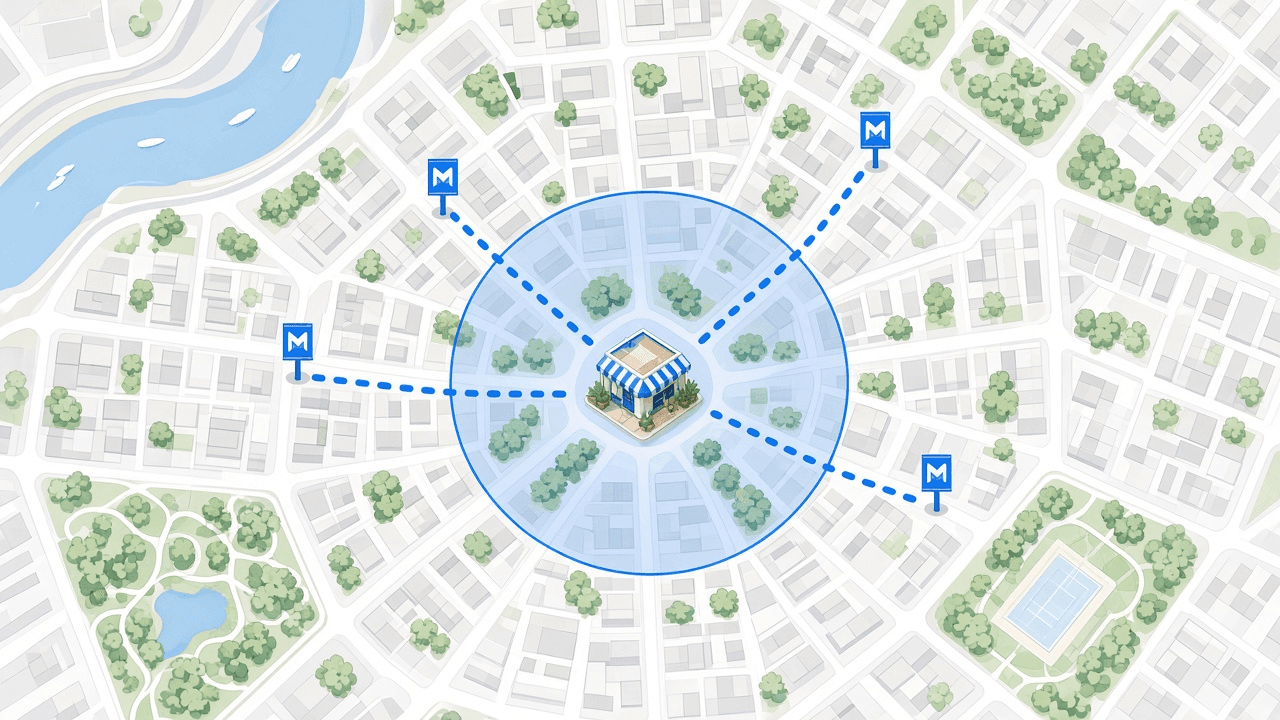
The neighborhood store owner does not think in CPM. They think about who walks past the door and who walks past the competitor's door. When the media owner sends a spreadsheet of addresses, or a Google Maps screenshot with little arrows, the owner cannot answer the only question that matters: "will this bring people to my store?"
Christmas and the January sales are brick-and-mortar campaigns, and the regional retailer decides at the last minute and wants to see the map. Whoever builds the proposal from the advertiser's address, not from what the media owner has free, speaks the retailer's language.
This text is a method: the radius around the store, the access route and the points near the competitor. And an honest caveat that applies from the start: a fixed radius is a starting point, not a rule.
Start from the advertiser's address, not from your inventory
The traditional proposal goes from inventory to client: "I have these 12 free points, pick one." The local retail proposal goes the other way. You ask for the store address (and, if possible, the strongest competitor's), put it on the map and only then look at what your company has around it.
That changes the conversation. Instead of price per face, you show proximity: "this face is a few blocks from your door, this other one is on the avenue your customer arrives by." The retailer sees what they are buying.
What is the store address? Where do customers come from (neighborhood, nearby town, highway)? Who is the closest competitor? Is the campaign an offer (price, sale) or brand reminder? The answer to the last question changes which points you choose.
The three layers of the map: radius, route and competitor
| Layer | Question it answers | What to look at on the map |
|---|---|---|
| Radius | What is near the store? | Faces inside circles around the address: a short ring and a second, wider one |
| Route | Where do customers pass on the way? | Avenues and access roads leading to the store, and which way traffic flows |
| Competitor | Where does the customer decide which store to visit? | Faces near the rival and on the stretch between the two stores |
Circles are for conversation: a short radius and a larger one give the retailer a visual ruler. But the ring sizes are method suggestions, not a market standard. Every city has its own street layout, rivers, overpasses and travel habits. A circle that crosses an expressway with no crossing point is not "near" for anyone.
The JMR study, only as an analogy
There is academic research that pokes at exactly this idea that radius does not tell the whole story. It is an article in the Journal of Marketing Research (Luo and Ranjan, 2025, vol. 62, no. 6) that combined TV ad viewership data with mobile location data from 6.4 million users to study retail ad effectiveness in the home improvement sector (article DOI; record checked on Crossref).
The study measures TV ads, in a single sector (home improvement). It does not measure billboards, does not measure the Brazilian market and proves nothing about your face. We use it here only as an analogy about distance and competition, which is what the article's own abstract allows us to say.
According to the abstract, the authors contradict the conventional focus on radius-based targeting and find that spatial variation is more nuanced. On three points:
- Position relative to the rival matters. The store's proximity to its competitor moderated ad effectiveness.
- Distance is not a straight line. Ad effect has an inverted-U relationship with the customer's distance to the store: neither the closest nor the farthest respond the same way.
- Ad type changes the radius. Price-promotion ads tend to influence customers closer to the store and steal rival traffic, compared with non-promotional ads.
Translating this to billboards is a hypothesis, not a result: if distance is not linear, the ring closest to the store may not be the best place for every campaign, and the competitor's position belongs on the map. That is why the method has three layers, not one.
Want to see the radius-and-route proposal in practice? The video presentation shows the proposal map, from the point record to the link the client opens.
See the radius and route proposal →The video is in Portuguese.How to build the proposal, step by step
What to tell the retailer about reach
They will ask "how many people see it?" Be careful with a loose number. Mobility data, explains Portal Meteoro, are aggregated records of where groups of people move, extracted from cell-phone signals, and are used to estimate reach and frequency for a set of panels. The limit is that the data only works if nobody can be identified from it, and each source (carriers, apps, sensors) has its own bias. The metrics standard presented by ABOOH on April 30, 2026 accepts several technologies as long as the methodology is documented, according to the same article.
In practice, for local retail: say where the number comes from, say it is an estimate and always go back to their question, which is store traffic. If you do not measure sales, do not promise sales.
How this looks in Hivestr
Hivestr is an ERP and CRM for OOH and DOOH media owners: inventory, proposals, reservations, campaigns and finance. It is not a screen CMS and does not sell programmatic media. For the local retail proposal:
- "Add Media" step. Point selection in the proposal has Grid, Map, Insertions, Radius and Route views, plus the "Only available" filter.
- Public link with a map. The client opens the proposal online and sees the Media Map with traffic, streets and businesses, items with photos and the investment summary.
- One-click approval and point reservation. The retailer confirms the campaign through the link, with no email exchange.
Want to go beyond sending? The Embed Map puts your inventory map on the media owner's website, and Mapa de Mídia Automatizado (in Portuguese) explains how inventory becomes a real proposal. To understand why seeing traffic changes the conversation, read O mapa que fecha contratos (in Portuguese).
Frequently asked questions about radius and route proposals
What is the best radius around a store for a billboard campaign?
There is no right radius for all retail. Start with a short circle around the store, open a second ring and compare it with the route customers take to get there. A fixed radius is a conversation starter, not a market rule; what decides is where buyers actually pass.
Radius or route: which matters more for local retail?
They answer different questions. The radius shows what is near the store. The route shows where customers pass before arriving. For a neighborhood store, the radius is often enough. For a store that draws people from afar, the route and access roads weigh more.
Is it worth putting a billboard near the competitor?
It can be, especially with an offer message. An academic study of TV ads in the home improvement sector found that the store's position relative to its rival moderated ad effectiveness. It is a TV study, not a billboard one, so treat it as a hypothesis to test, not a promise.
Do I need mobility data to build the proposal?
Not to start. An address, a map, the access route and your inventory already help you make a proposal a retailer understands. Mobility data adds reach and frequency, but it is an aggregate with each source's own bias, and no map number replaces the conversation about the store's goal.
Does Hivestr build the proposal by radius and route?
In the proposal's add-media step there are Map, Radius and Route views, plus an Only available filter. The proposal's public link shows the media map with traffic, streets and businesses. Which points to include is still the media owner's decision.
Sources consulted
- Luo, B.; Ranjan, B. "Mapping Spatial Heterogeneity in Retail Advertising Effectiveness". Journal of Marketing Research, vol. 62, no. 6, 2025. doi.org/10.1177/00222437251328601 (abstract checked on Crossref on Nov 26, 2026).
- Portal Meteoro, Mobility data in media planning: how it works (Nov 6, 2026).
Data checked on November 26, 2026. The JMR study covers TV ads in the home improvement sector; it is used here only as an analogy. The radii and the step-by-step are method suggestions, not market rules. Names, points and examples are illustrative.
Your media company's whole operation
Inventory, proposals with online approval, CRM, campaigns, proof of posting and finance in one account. 7 days free to try.
Subscribe to the Hivestr newsletter
Get tips, OOH/DOOH industry news, and Hivestr content straight to your inbox.