
Are You a Small-Time Manager or a Big-League Operator of Your OOH Business?
Nobody thinks of themselves as small-time. But the seven behaviors below reveal which mode you are actually running your OOH or DOOH operation in.
· Hivestr · 214 views
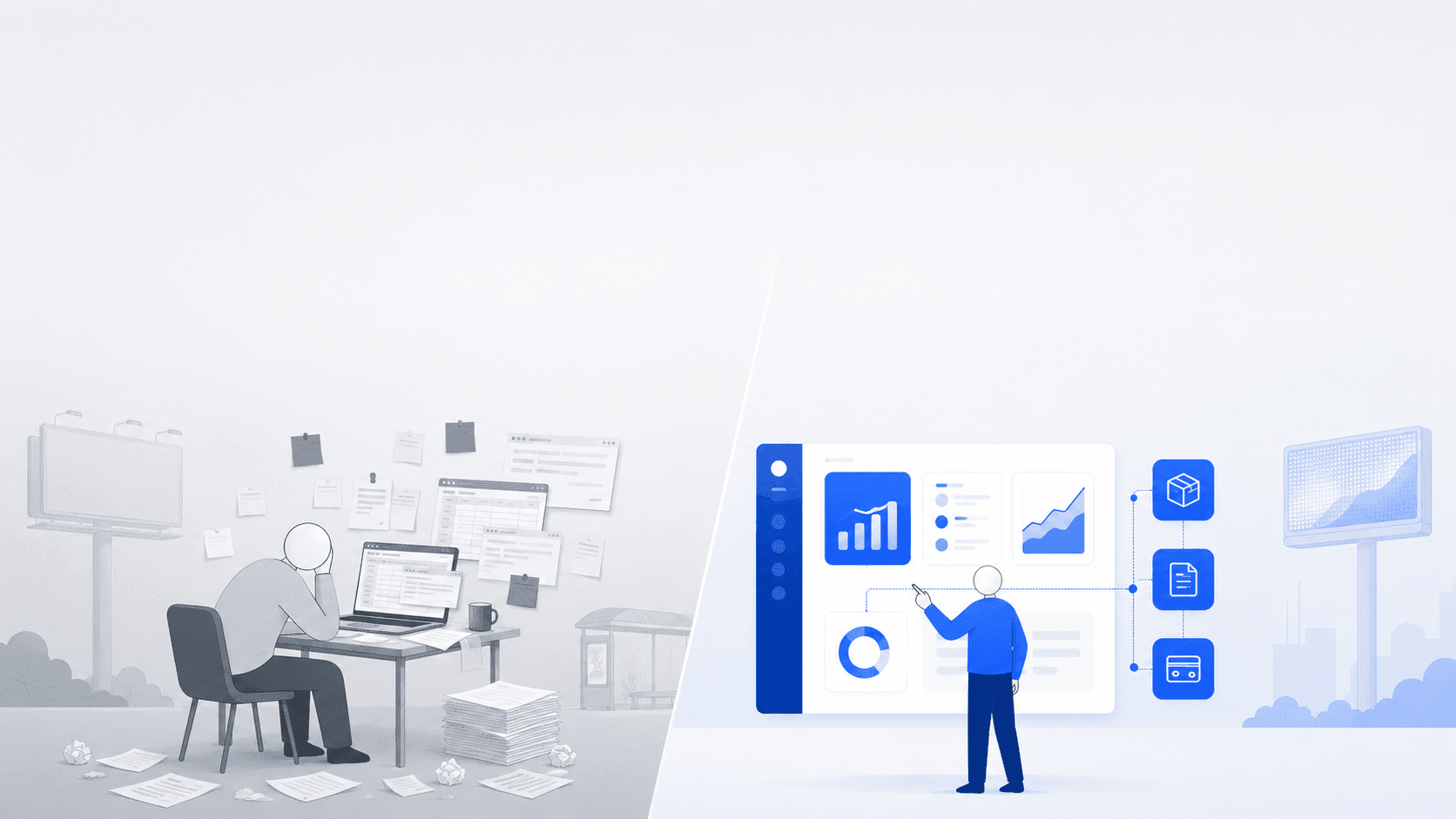
Nobody thinks of themselves as a small-time manager. Everyone feels they have the operation under control, that they know what is going on, that if they need any number they can just "take a quick look". The problem is that "a quick look" tends to become "let me ask someone", which becomes "we will cover that in Tuesday's meeting". And the control that felt solid turns out to have been just familiarity with the chaos.
This article is not a judgment. It is a mirror. The behaviors below separate two ways of running an OOH or DOOH media company, and the difference between them is not talent or effort. It is visibility. Read and see where you recognize yourself.
Knows what happened last week.
Only finds out the state of the operation at the weekly meeting. Before that, depends on someone putting together a summary.
Knows what is happening right now.
Opens the system and sees in real time: occupancy, open proposals, contracts coming up for renewal, overdue payments. No need to ask anyone.
Inventory lives in the salesperson's head.
To find out if a face is available, someone has to ask the salesperson. If the salesperson is busy, the answer waits.
Inventory lives in a real-time map.
Anyone on the team can check availability in seconds. The occupancy calendar is always current, without depending on someone remembering to update a spreadsheet.
Renews contracts by luck.
The client calls asking what is going to happen with their campaign. The team scrambles to check the expiry date and sends a proposal in a rush.
Renews contracts by process.
The system flags an upcoming expiry with plenty of notice. The team reaches out before the client calls, with a prepared proposal ready. Renewal becomes routine, not a fire drill.
Grows and loses control at the same time.
More faces, more salespeople, more contracts, more the operation depends on everyone's memory. Growing becomes a synonym for more stress.
Grows and keeps visibility.
The process does not depend on any one person. Every area of the business has an owner and an updated data source. Growing becomes a synonym for gaining scale, not losing sleep.
The meeting exists to discover what happened.
Every week the team gathers to piece it together: what was sold, what is free, what expired, what got stuck. The meeting is the only moment when anyone has the full picture.
The meeting exists to decide the next move.
Everyone arrives already knowing what is going on. The conversation is about priorities, course corrections and opportunities. Thirty minutes resolves what used to take two hours.
When they leave, the operation stalls.
If they travel, take a holiday or spend a day offline, someone stops everything waiting for an approval or a piece of information only they have.
When they leave, the operation runs.
The information is in the system, not in anyone's head. The team knows what to do. The company does not depend on the owner being physically present to function.
Decides on gut feel.
There is no way to know precisely which area performs best, which format brings the highest return or which salesperson is converting the most. Decisions are based on perception.
Decides on data.
Occupancy rate by unit, average deal value by format, conversion by salesperson, revenue forecast. The data is available before the decision, not after the mistake.
Nobody starts out as a big-league operator
Every big-league operator was once a small-time manager. The difference is not natural talent, a degree or company size. It is the moment the person decides to stop operating in the dark and builds a structure that works without depending on their memory.
That moment is almost always accelerated by a specific pain: a contract lost for lack of follow-up, a unit sold twice, a tight month because nobody tracked the receivables. Pain is the catalyst. But you do not have to wait for the pain to act.
The operation you want two years from now will not appear on its own. It is built today, piece by piece: organized inventory, a visible sales pipeline, tracked contracts, up-to-date finances, measured performance. It does not need to happen all at once. It needs to start.
From the spreadsheet to the dashboard. From small-time to big-league.
Hivestr is the ERP, CRM and marketplace built for OOH and DOOH media companies. Inventory, proposals, contracts, finances and performance integrated in one place, so your operation stops depending on memory and starts depending on process. Try it free for 7 days.
Explore Hivestr · 7-day free trial →Your media company's whole operation
Inventory, proposals with online approval, CRM, campaigns, proof of posting and finance in one account. 7 days free to try.
Subscribe to the Hivestr newsletter
Get tips, OOH/DOOH industry news, and Hivestr content straight to your inbox.